

The first tool is a question.
A story invites us to look. A bench asks us to try.
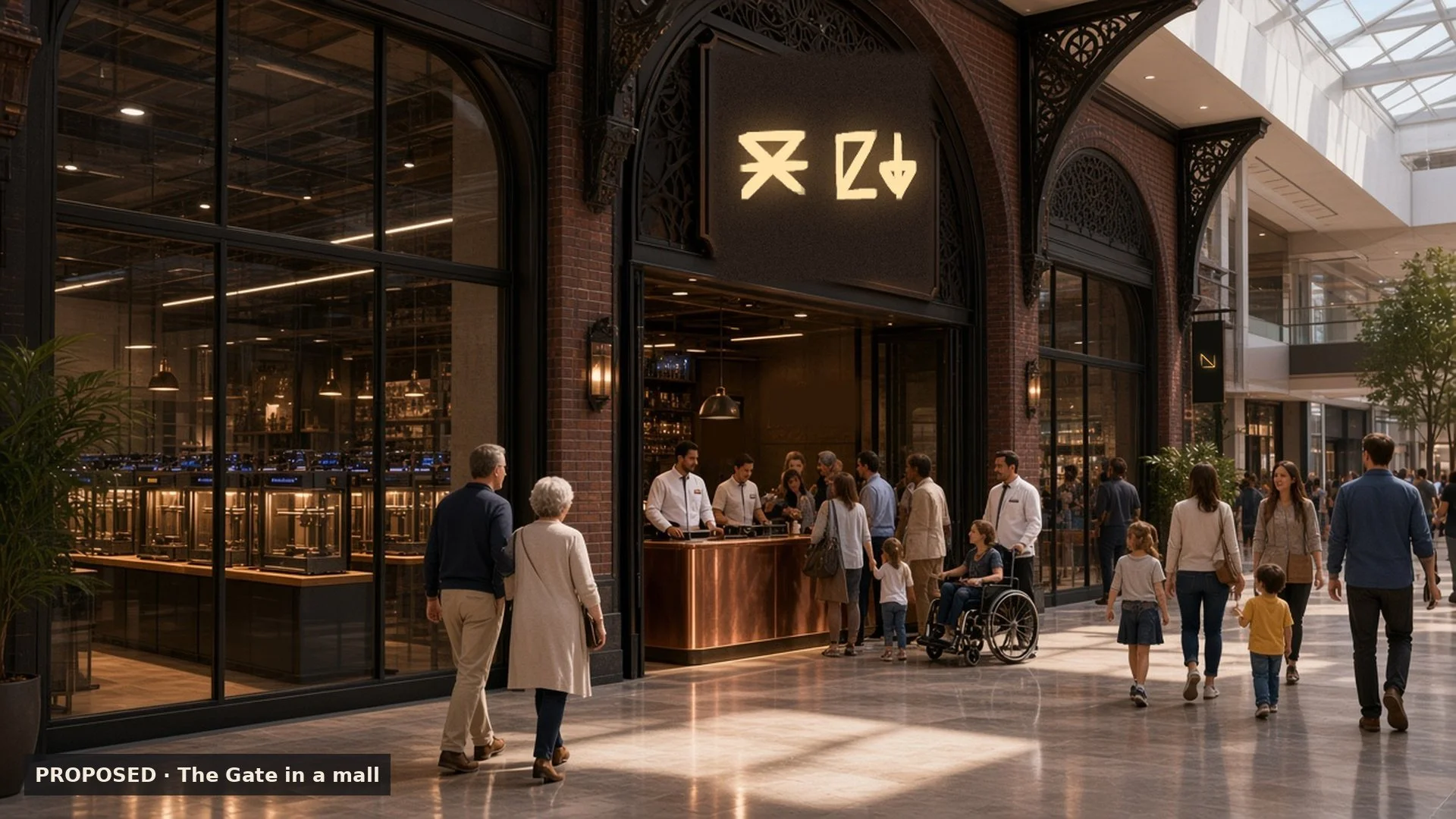
Singular City: The Gate
Arrive at Level 0. Level up through real quests.
The Gate is the first piece of Singular City you can walk into PROPOSED. A small place in a mall, built the way arcades are built and themed the way the best parks are themed, where a six-minute ride tells you a story and a bench lets you do the real thing: print a working object, wire a solar lamp, filter a liter of water, seed a tray you will come back to harvest. What you make, you keep. What you learn, we record. The record is your level.
The Gate is also the public floor of a laboratory. The first thing Singular City builds is not a city; it is one lab with a published schedule of what it will prove, and the Gate is where the lab's lessons meet people.
Singular City: The Gate is a proposed concept. Plans, not commitments.
What the Gate is
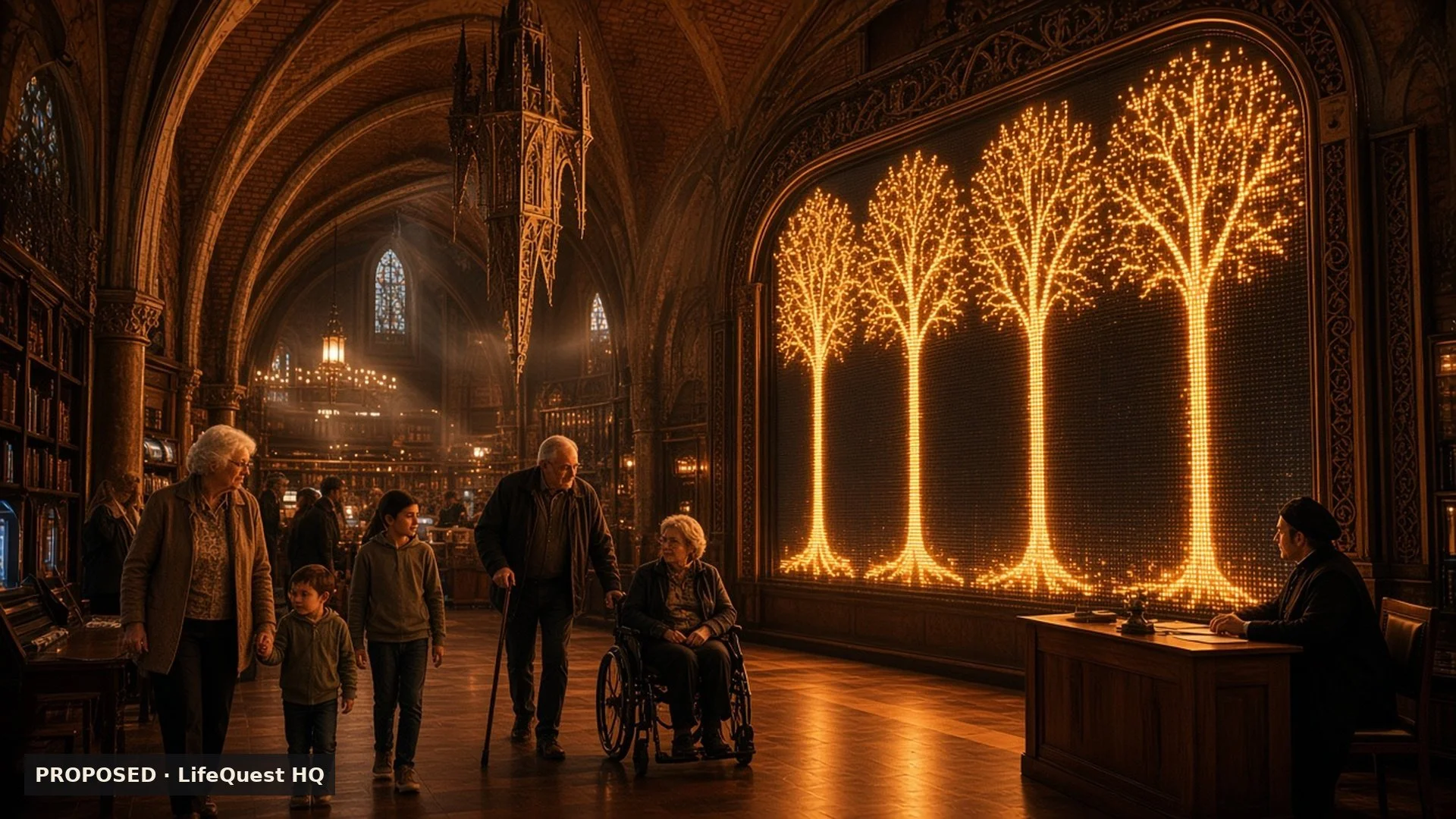
The Gate is a skills arcade of about four to five thousand square feet in a Florida mall PROPOSED. You get a wristband at the door. It is your Level 0 badge. Inside there are four halls, two Training Ride pods, a quest board, and a market. You choose a path, ride a short lesson, and then go to a bench where a Guide helps you do the thing the ride just showed you. The lamp lights. The print comes off warm. The liter clears. The tray goes under the lights with your name on it.
Every quest you finish goes on your record as experience. Experience is your level. Nobody can buy it, and nobody can take it away. Credits are different: you can buy them or earn them by finishing quests, and they pay for extra rides, materials, kits and things in the market. Credits never turn back into cash and never move from one person to another. Levels and credits never touch.
The Gate is a test, and it says so. The Singular City papers do not describe a city that exists; they describe a research program, the measurements that would show it working, and the results that would tell it to stop. The Gate is where the part of that program about people is run, with consent, in public, and improved every month. It publishes what works and what breaks, including the failures.
How a visit works
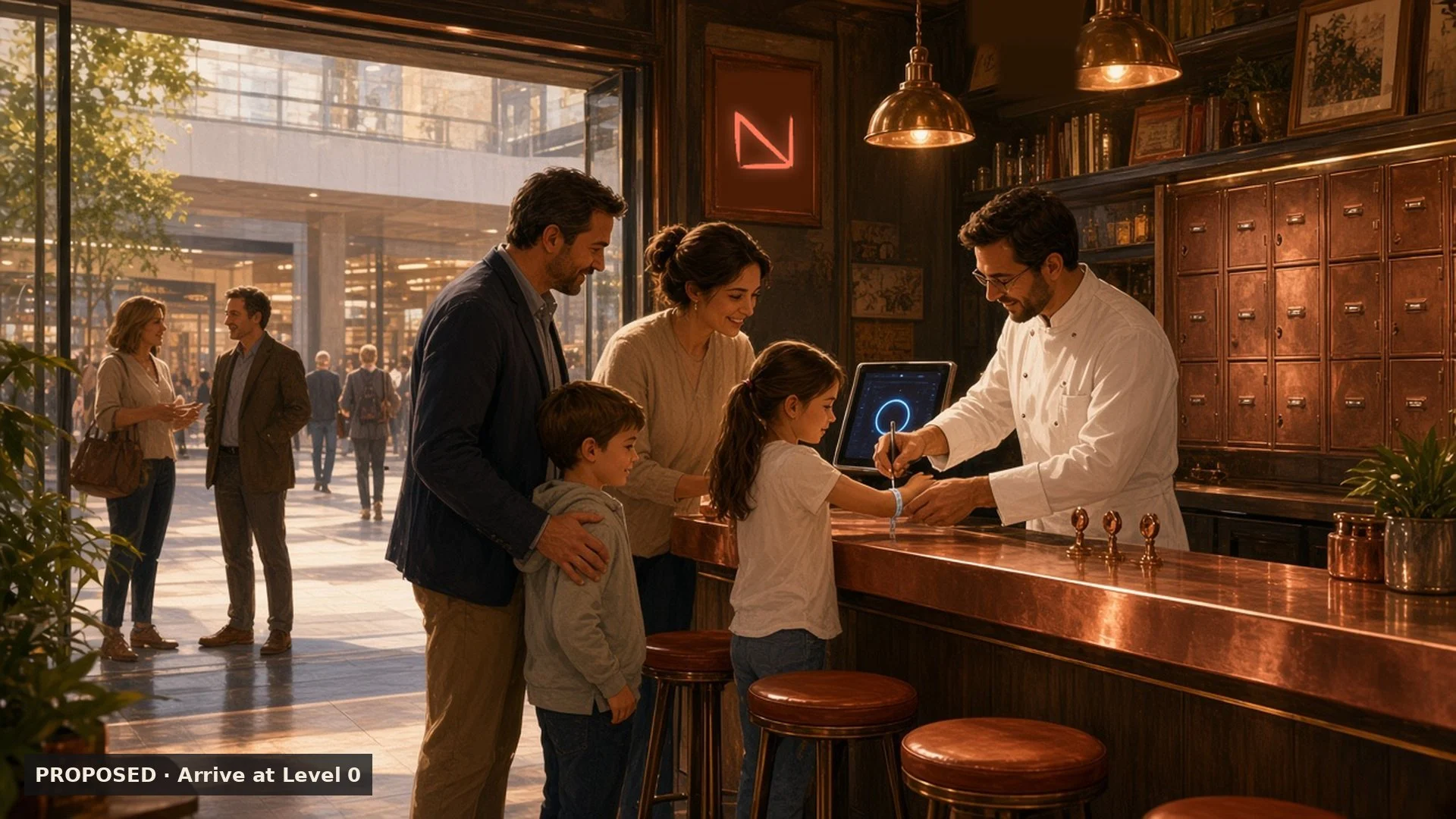
1. The Gate. Book a three-hour session. At the door, each guest gets a wristband. Children's profiles sit under a parent's account, which the parent signs for at the counter. The two marks over the door mean Welcome.
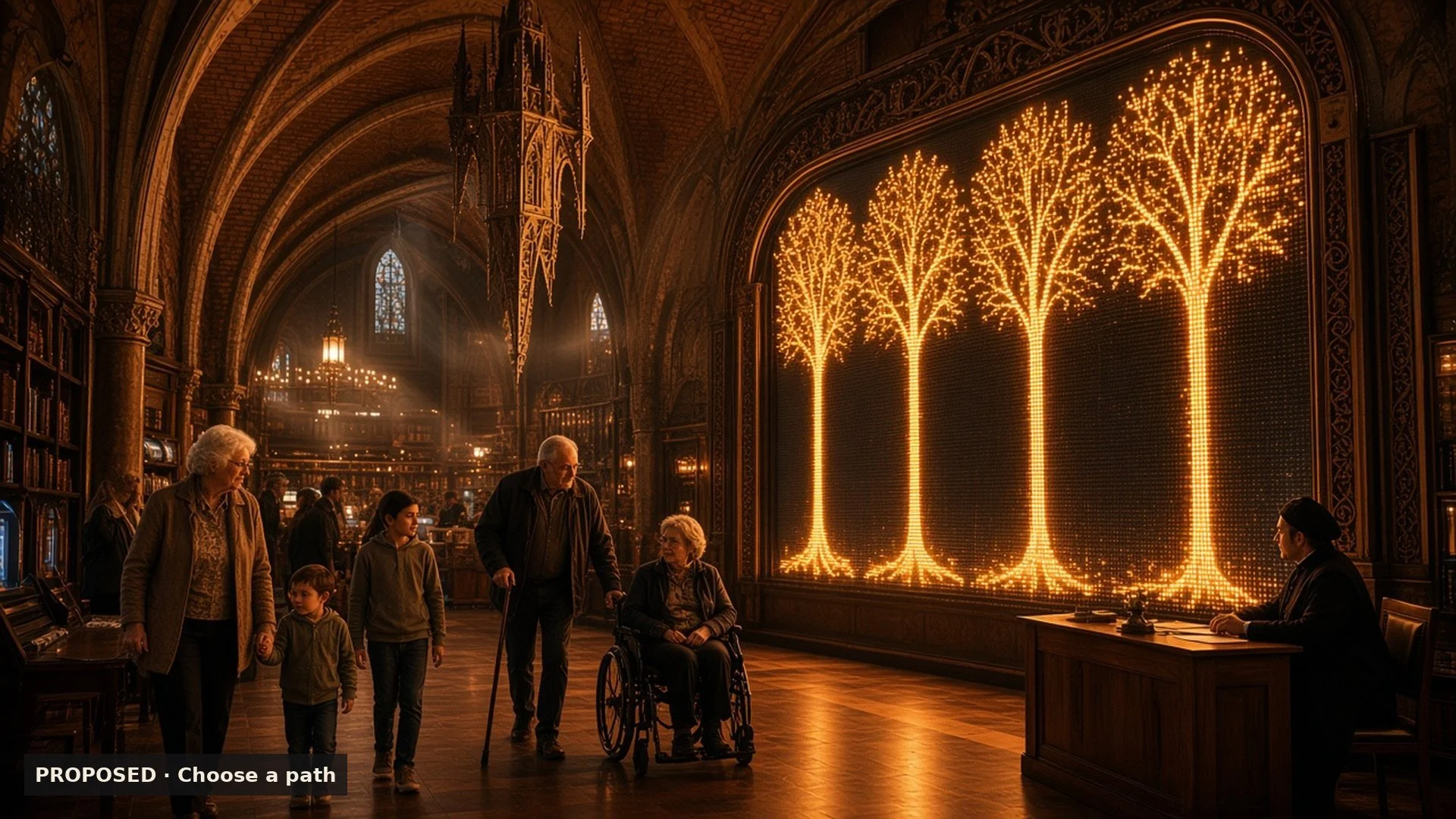
2. LifeQuest HQ. The quest board shows four paths as four corridors: Energy, Water, Manufacturing, Food and biology. Tap the Discovery stations along the wall for your first experience; two of them teach you the four labels and the eight-material ladder the lab is climbing. Choose a path. Your first quest appears on your wristband.
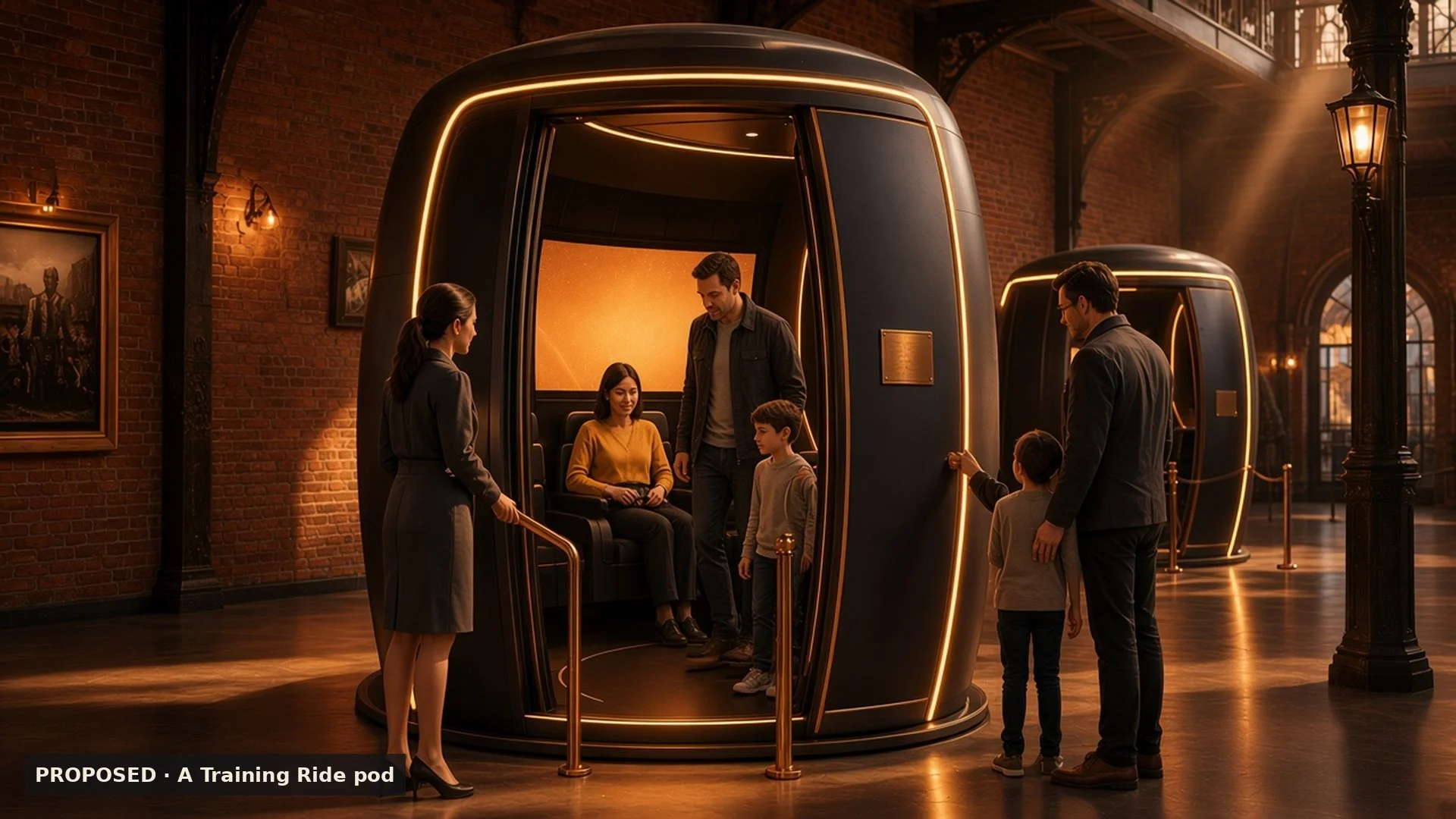
3. The Training Ride. A six-minute seated lesson in a pod with a wraparound screen, sound, wind and warmth, and no motion. It is a story, and the card says so. It ends by naming your first quest and the label of the thing you are about to make.
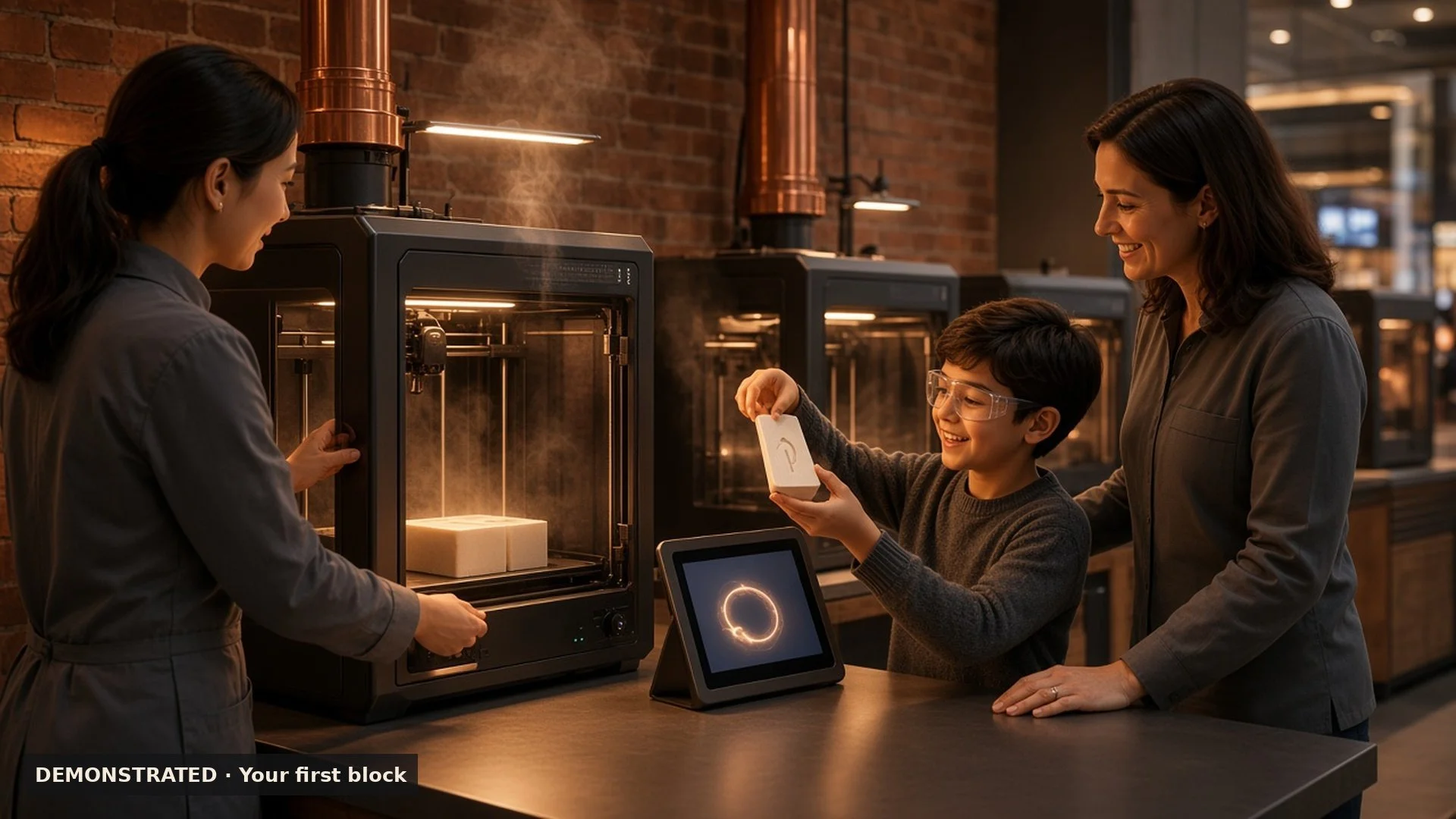
4. The bench. Twenty to thirty minutes with a Guide. You assemble the lamp, print the block, build the filter. The Guide checks it the only way that counts: it lights, it passes the tap test, the water clears. Your wristband records the quest.
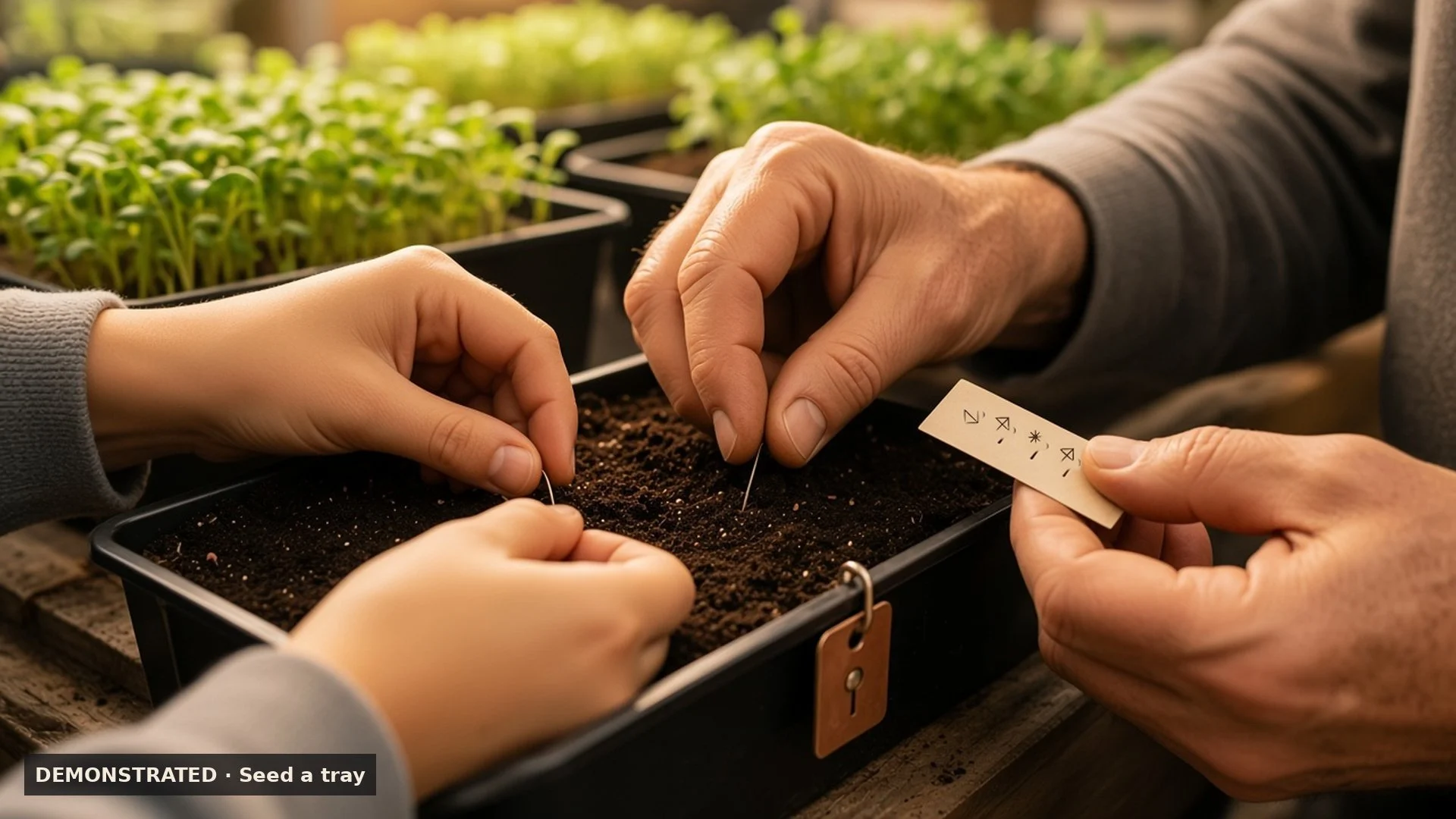
5. The Grow Hall. Seed a tray. It needs ten days under the lights, and the app tells you when it is ready. Plants do not hurry, and neither does this quest.
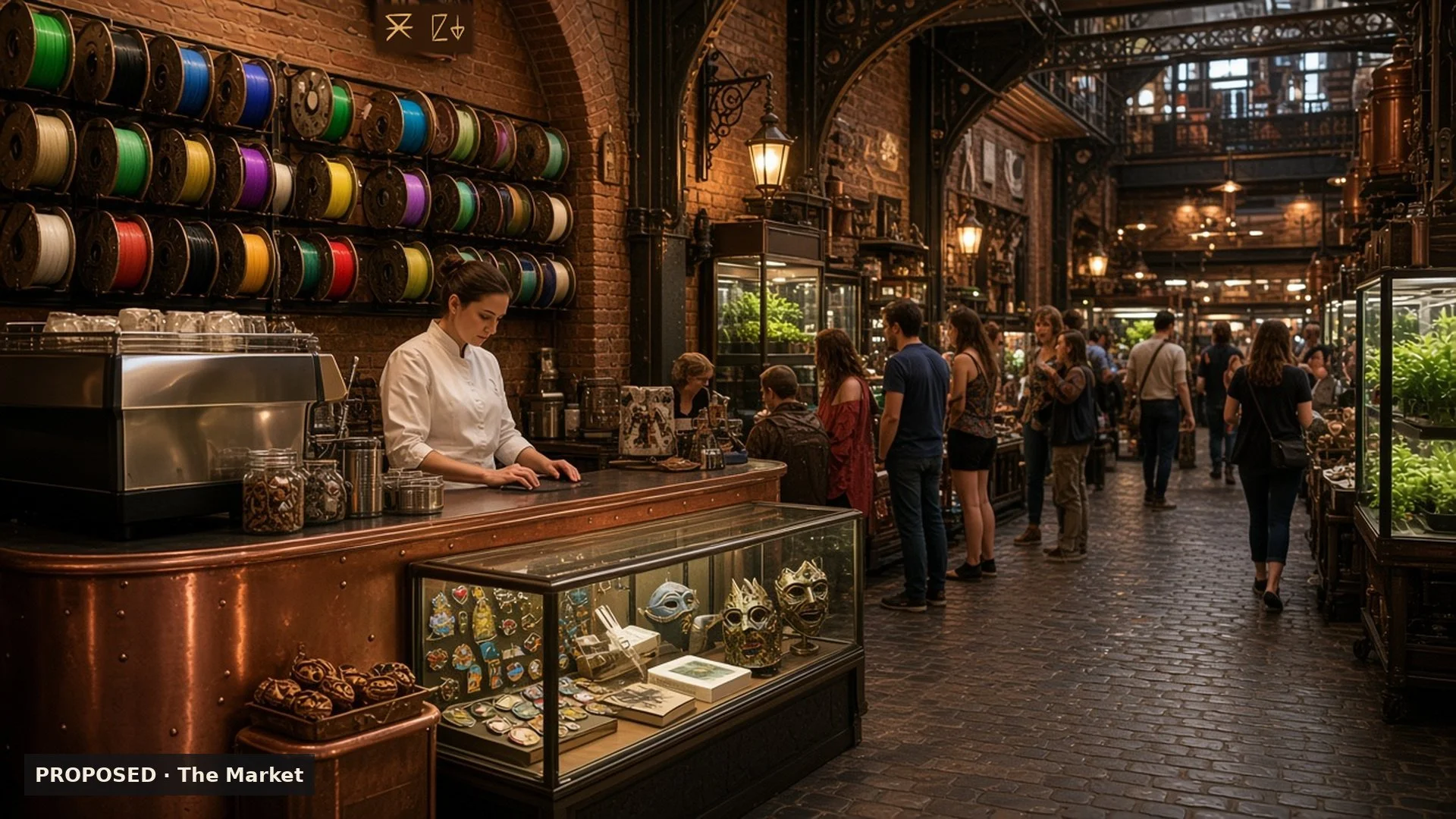
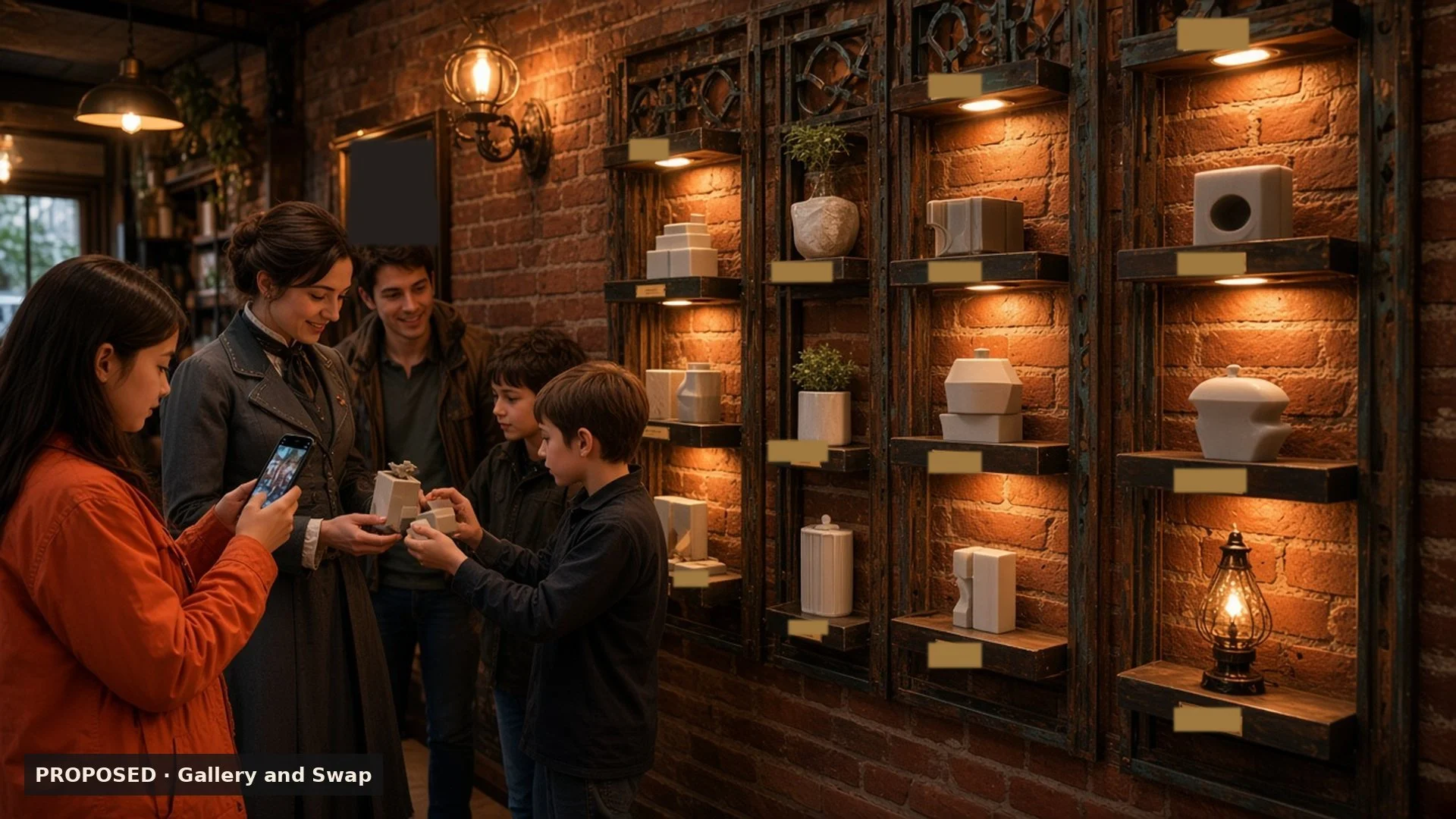
6. The Market. Buy materials, seed pods and kits with credits. Put your object on the Gallery wall for a photo. Swap it with another maker if you like. Then take it home.
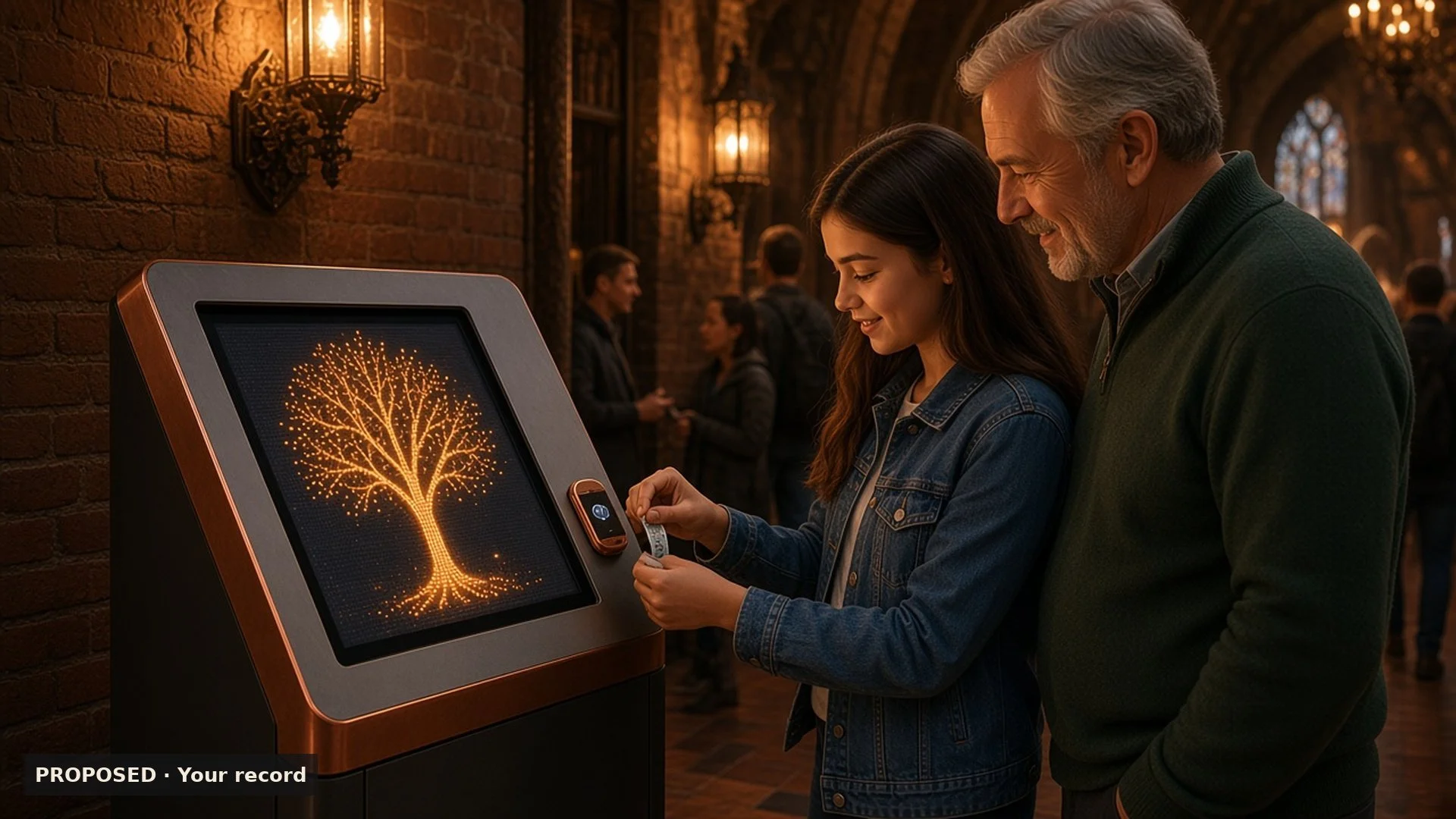
7. The record. On the way out, the board shows your level, your next quest, and the date your tray is ready. Your badges are yours: they export to any badge wallet, and they stay yours if you never come back.
The four halls
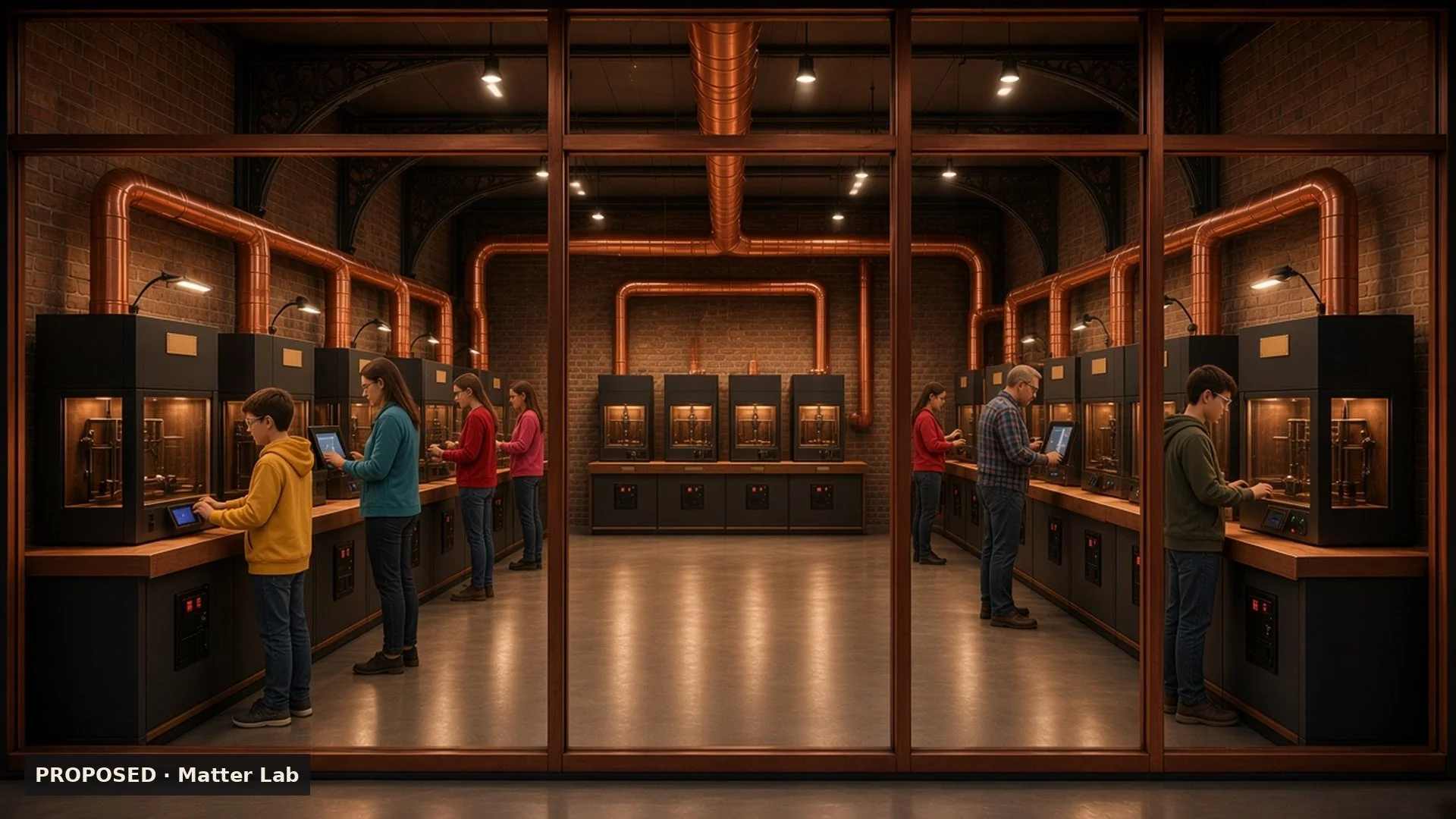
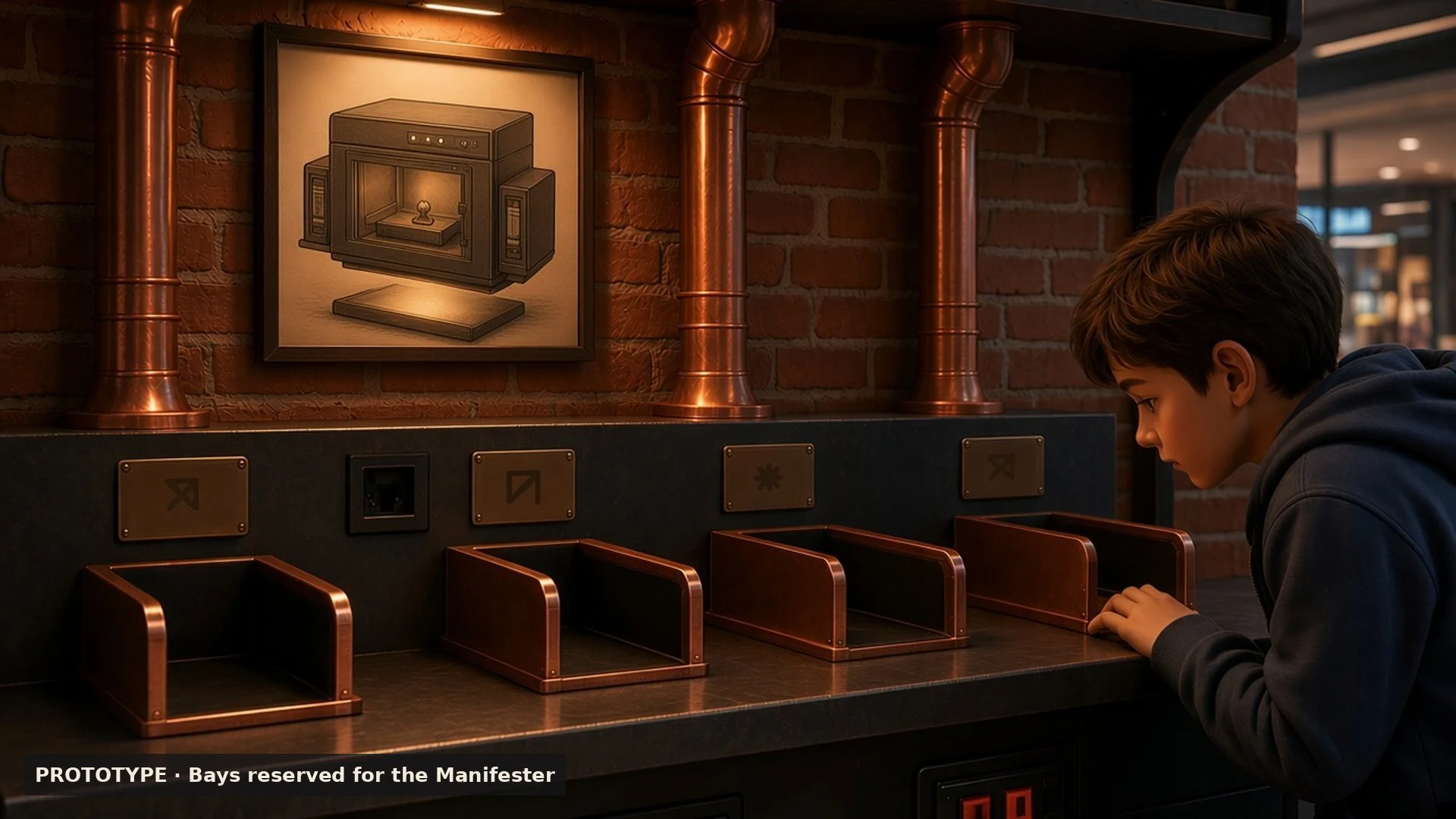
Matter Lab. What you learn: how a printer turns a material into an object, how a functional material can carry soap or a solar cell through a hot nozzle (at the level of the published patent application), and how to fix a print that went wrong. What you make: your first block DEMONSTRATED, a soap object PROTOTYPE, a filter housing DEMONSTRATED, a planter from pellets DEMONSTRATED. What you keep: all of it, stamped with your mark. Four bays at the end of the hall are kept empty, wired and ready for the Manifester PROTOTYPE. Every material on the bench carries its label and the evidence level the lab has given it.
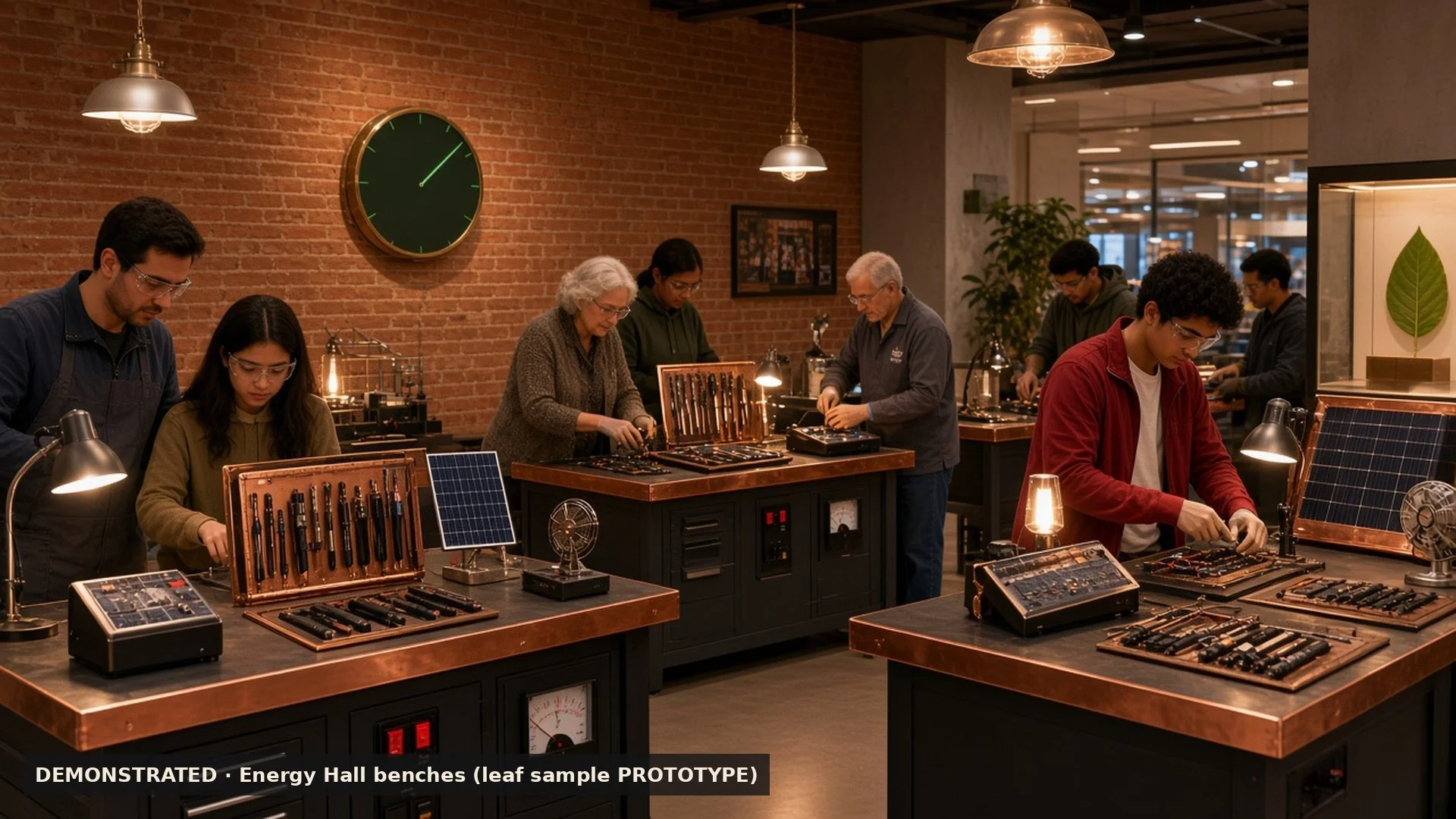
Energy Hall. What you learn: light to current, series and parallel, batteries and charge control, and why nothing you touch here exceeds 24 volts. What you make: a solar lamp DEMONSTRATED, a commercial silicon kit, a working 12 volt bench circuit DEMONSTRATED, a fault you found and fixed DEMONSTRATED. What you see under glass: the printed photovoltaic leaf PROTOTYPE, with its card stating what the paper states, that its power density is today roughly an order of magnitude below a commercial silicon module, and that the gap is reported as a gap. What you keep: the lamp, and a second one you can give away through the Make and Give quest.
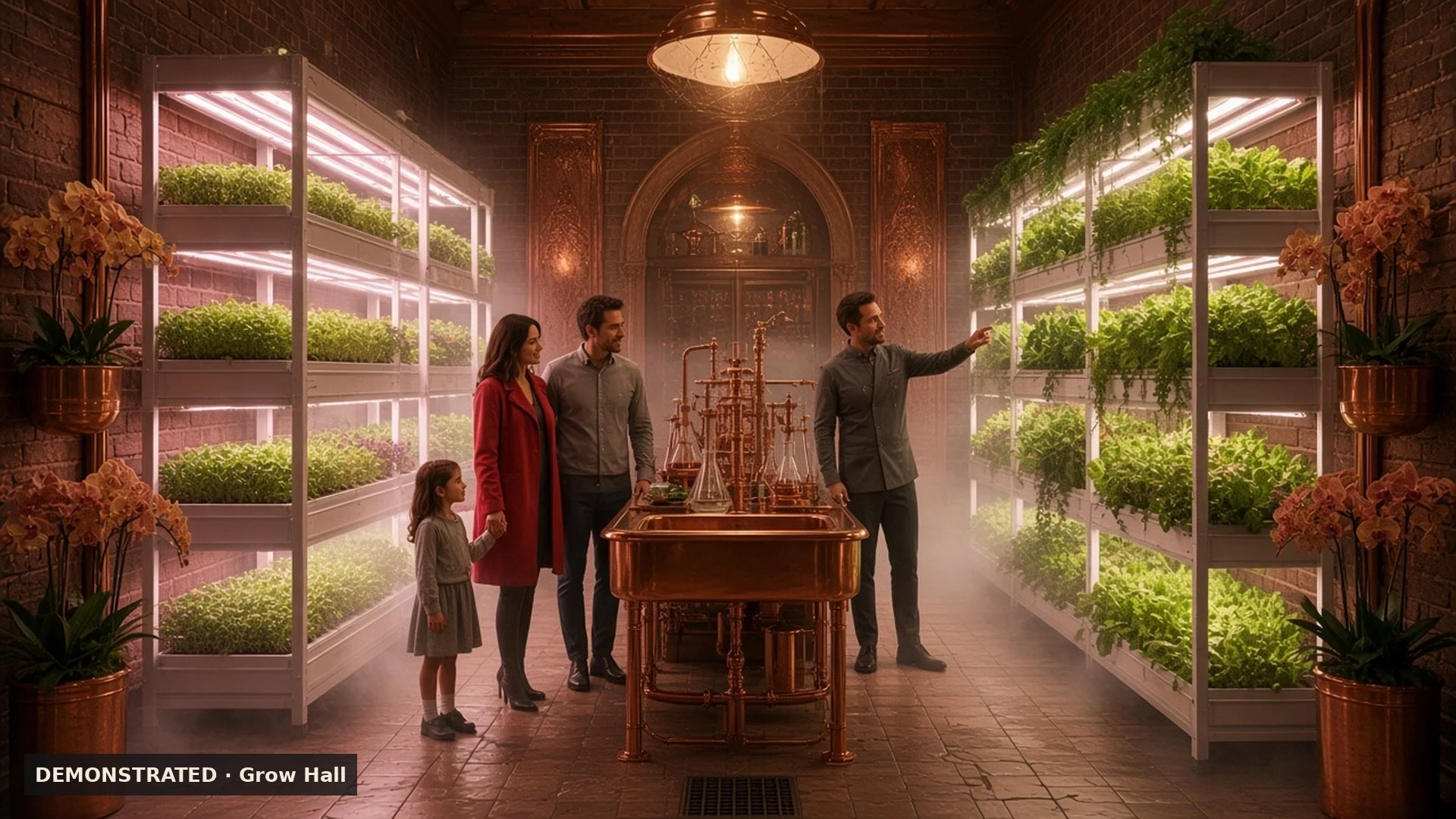
Grow Hall. What you learn: how plants grow without soil, how a nutrient loop works, and how a seed pod can carry its own water and food on a schedule written into its shape. What you make: a tray of microgreens DEMONSTRATED, a planted Bloominite pod PROTOTYPE: patented, shipped, and measured the way the papers say it must be, by how many seedlings establish and on how much water, before any larger claim is made, a tower you transplanted into DEMONSTRATED. What you keep: the harvest, boxed to take home. The Grow Hall teaches; it does not claim to feed anyone.
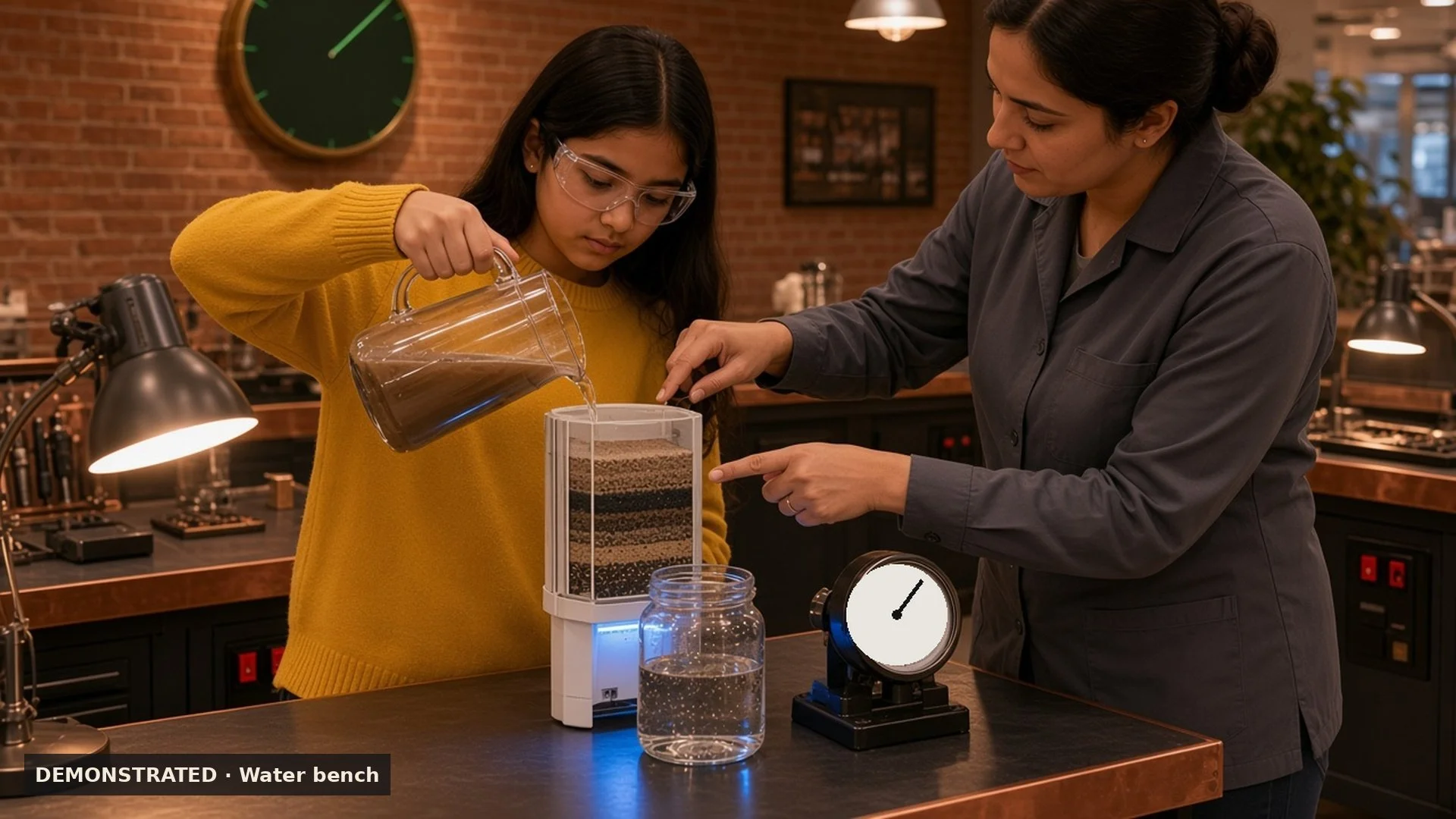
Water benches. What you learn: what turbidity is, how media filtration and membranes work, and what desalination costs in energy. What you make: a gravity filter that clears a cloudy liter, measured on a meter. What you keep: the filter, labeled as a learning prototype, not a drinking-water device. The printed desalination filters of the film are PROPOSED and are not on the bench.
The Training Rides
A Training Ride is a six-minute seated lesson in a pod. It is not an amusement ride: the seats do not move. It is not a course: it will not make you a technician. And it is a story, built from the film, labeled as story on the card and at the door. It is the hook that gets you to the bench, where the learning happens and where the labels are real.
R0: The Descent. The rules of the venue in five minutes: levels, credits, the board, the gates, the four labels, where to appeal, and the exit that is always open. Everyone's first ride.
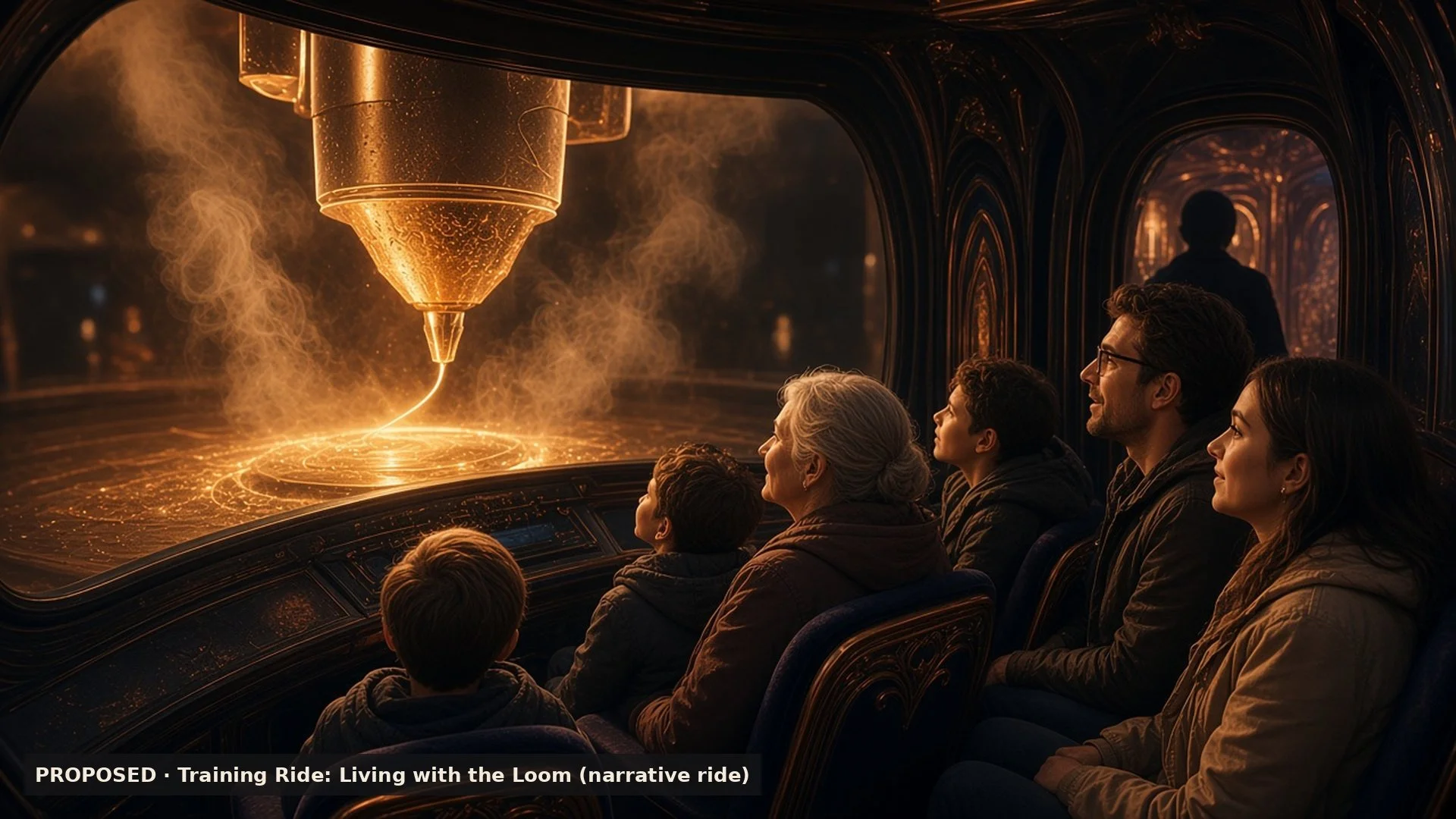
R1: Living with the Loom. How a functional material survives the nozzle, and what the nine marks on the walls mean. Ends with your first print queued DEMONSTRATED.
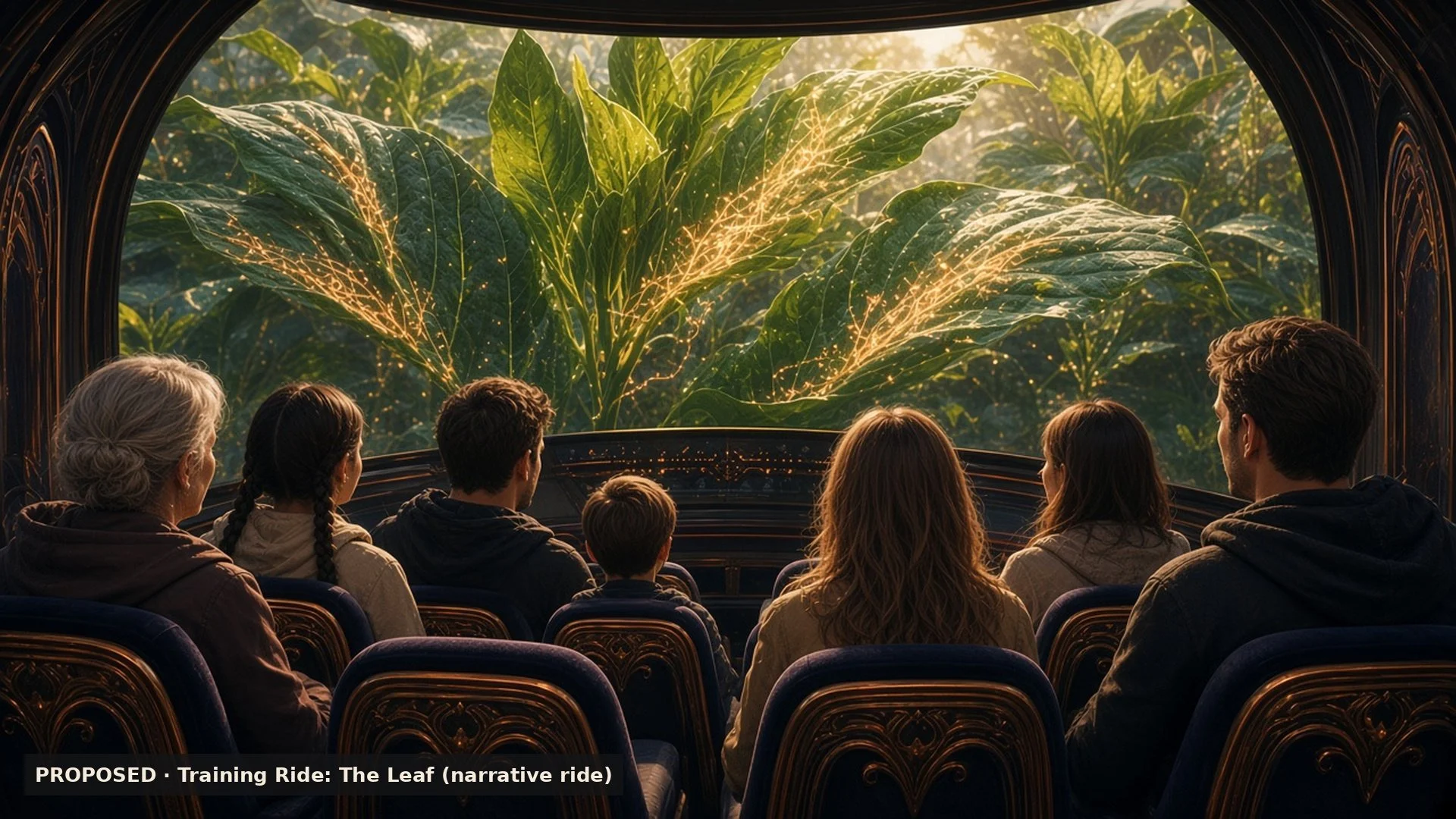
R2: The Leaf. Photons to electrons, series and parallel, and the printable leaf PROTOTYPE. Ends with the lamp DEMONSTRATED.
R3: Under the Hollow. Filtration, membranes, and why water quests are gated. Ends with a cloudy liter waiting for you DEMONSTRATED.
R4: The Grow Hall. Hydroponics, the nutrient loop, and a seed pod that keeps time because its shape is a program. Ends with a tray DEMONSTRATED.
R5: Gravity Pays. Batteries, the microgrid, the Dial beside the Floor, and what a watt is at the scale of a house, a city, and a planet. Ends with a fault to find DEMONSTRATED.
R6: Lift. How to teach a quest you have done, with a Guide present. Ends with the right to mentor a newcomer.
Levels and credits, explained
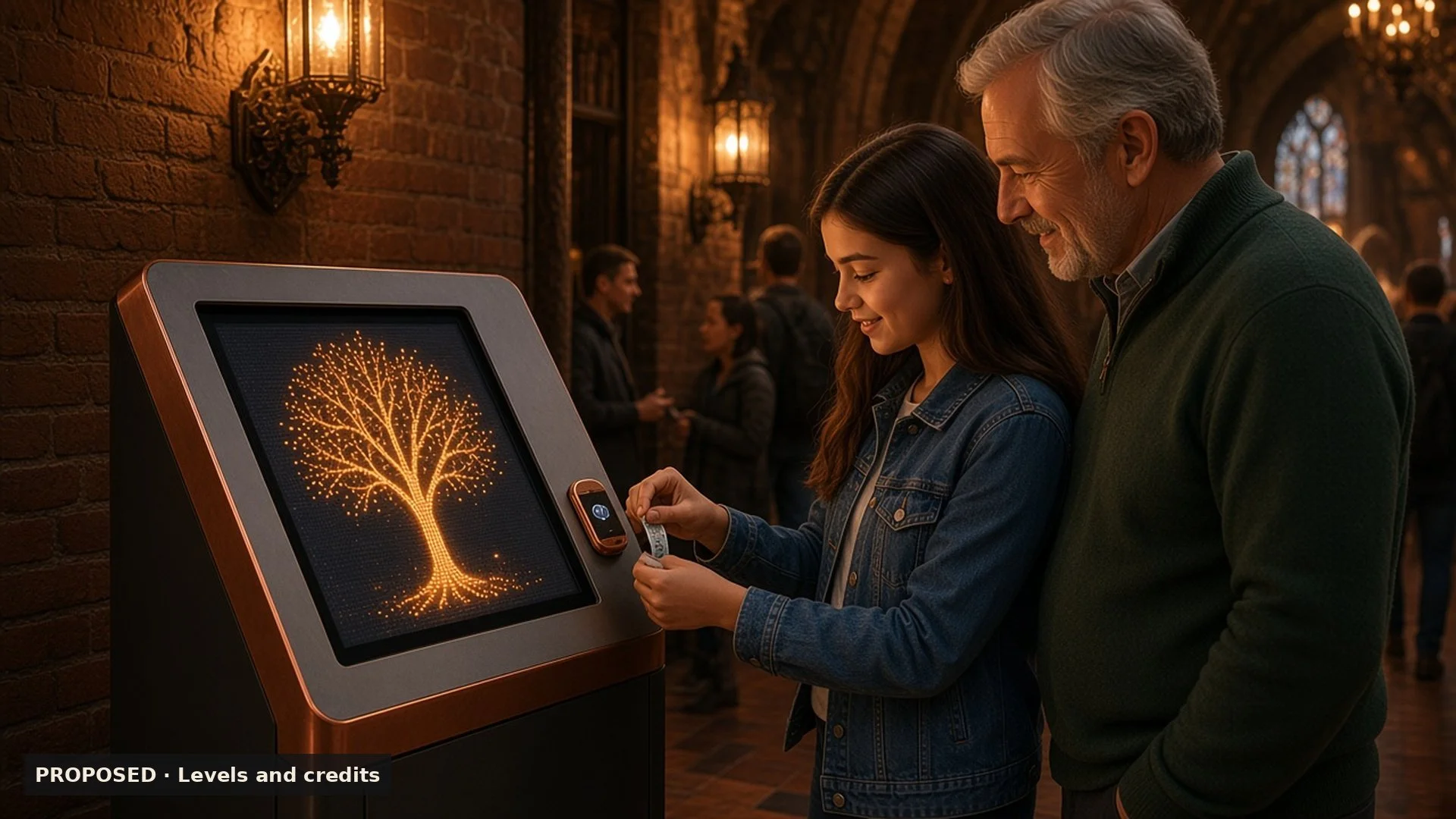
Four things that never mix. The papers draw a line the Gate keeps: your rights, your skills, work, and recognition are four separate things, and the Gate's software keeps them in four separate places. Your rights (getting in, being safe, leaving, appealing, taking your record) never depend on your level. Your skills (the badges that say what you can do) open quests, and nothing else. Work is what the paid staff do, and no quest is ever a job in disguise. Recognition (experience, levels, teacher marks) is shown, never used to decide anything about you.
Rights do not level up. Nothing you are entitled to at the Gate changes with your level. Not entry, not safety, not the exit, not the appeal.
Levels are a record, not a ranking. Your level is a number that says how broad your record is: rides taken, quests finished, people you have taught. Level 0 is the wristband. Level 1 is your first ride. Level 30, Citizen of the Gate, is every quest the Gate offers on every path, plus teaching. The board never shows a leaderboard, a streak, or a loss. Your level is yours to show or not; nobody else sees it unless you choose. We do not score people, and we have no score of you.
Experience cannot be bought. The only way to earn experience is to do a quest and have a Guide check it. No pass, no membership, no amount of credits buys a level, a badge, or a place at a bench.
Credits pay for choices. One credit is one dollar. You can buy credits in packs, and purchased credits never expire and carry no fees. You also earn a small fixed number of credits every time you finish a quest, as a loyalty reward; earned credits expire after a year, and the balance always shows which is which. Credits buy extra ride seats, materials by the gram, kits, market goods and cafe items.
Credits never cash out and never move between people. They are not money, not a gift card, not a security, and not a token on any blockchain. They can only be spent at the Gate. You cannot send them to a friend, sell them, or trade them. This is what keeps the Gate honest and simple.
Nothing is decided by chance. Every reward is a fixed amount for a finished quest. There are no loot boxes, no spins, no raffles, no random drops, and no rewards that depend on a score.
The board's premium. When a bench is underused, the board raises the experience you earn there, by up to half, and prints the formula under the heading "Why this quest pays more right now." That is how the venue steers people toward what it needs without ordering anyone anywhere. Every month we publish what the premium actually did, because the papers say cooperation is something to measure, not to assume.
The exit is always open. Finishing a quest can never cost you anything you already had. Failing one costs nothing. You can leave at any time with everything you made, and you can see, export or delete your record whenever you ask.
What we do not collect about your child. A child's profile is a nickname, a level, a list of quests and a wristband number, under a parent's account. We do not collect photos, voice, location or biometrics from children. The app has no feed, no messages, no likes, and no infinite scroll. Parents sign for children under thirteen and can review or delete the record at any time.
The charter
A venue that asks you to play a game about a city owes you the rules of the venue in writing, before you arrive. The Gate's charter is eight promises the operator makes to you. They are written as things we may not do, because a promise like that can be checked. The full text is published before opening and printed at LifeQuest HQ; every change is public, and no change may take anything away.
Your floor cannot be suspended. Equal treatment, safety at every station, the exit with everything you made, due process, and the right to say no to any quest, ride or data use. A busy day does not change it. An emergency measure has an end date, a named person responsible, and a public record afterward.
The software decides nothing about you. The app can measure, schedule, recommend and warn. It cannot judge a dispute, impose a penalty, or change what you are entitled to. A person does those things, and you can appeal them.
We do not score people. Your record holds what you have done. Your level is a shorthand for how much is in it. There is no score of your behavior, your spending, or who we think you are, and nothing you get here depends on one.
We collect the minimum, and the record is yours. A nickname, a level, your quests, your credits, your wristband. No biometrics, no location tracking, no audio anywhere in the building. The cameras we do have are at three doors, for safety, with a sign at each, thirty days of retention, and no analytics. Anything we monitor, we declare here.
Work is work. No quest is a job. The people who keep the Gate running are paid, in dollars, under the law, and they keep the right to refuse dangerous work.
Inclusion is a design requirement. An accessible route to every bench, a wheelchair bay in every pod, captions and audio description, a calm version of every ride, quests you can do without reading English or standing up, and a yearly audit, run by people who do not work for us and published in full, of whether the game favors anyone. If it does, the game changes.
You can appeal anything, and you can always leave. Any decision about your access, your award or your record can be appealed to a human panel within thirty days. You get written reasons and the evidence. The final stage is two people the Gate does not appoint, from the university partner that hosts our lab and from the school district, and their ruling binds us. Leaving is unconditional, and your record goes with you in a format any badge wallet can read.
The charter only gets stronger. It is versioned, its history is public, it can only be amended upward, and once a year someone who does not work for us audits whether we kept it and publishes what they found, including where we failed.
The full charter text is published as a PDF at opening.
A charter written by the operator is still written by the operator. We say so, which is why the final word on an appeal is not ours.
For families
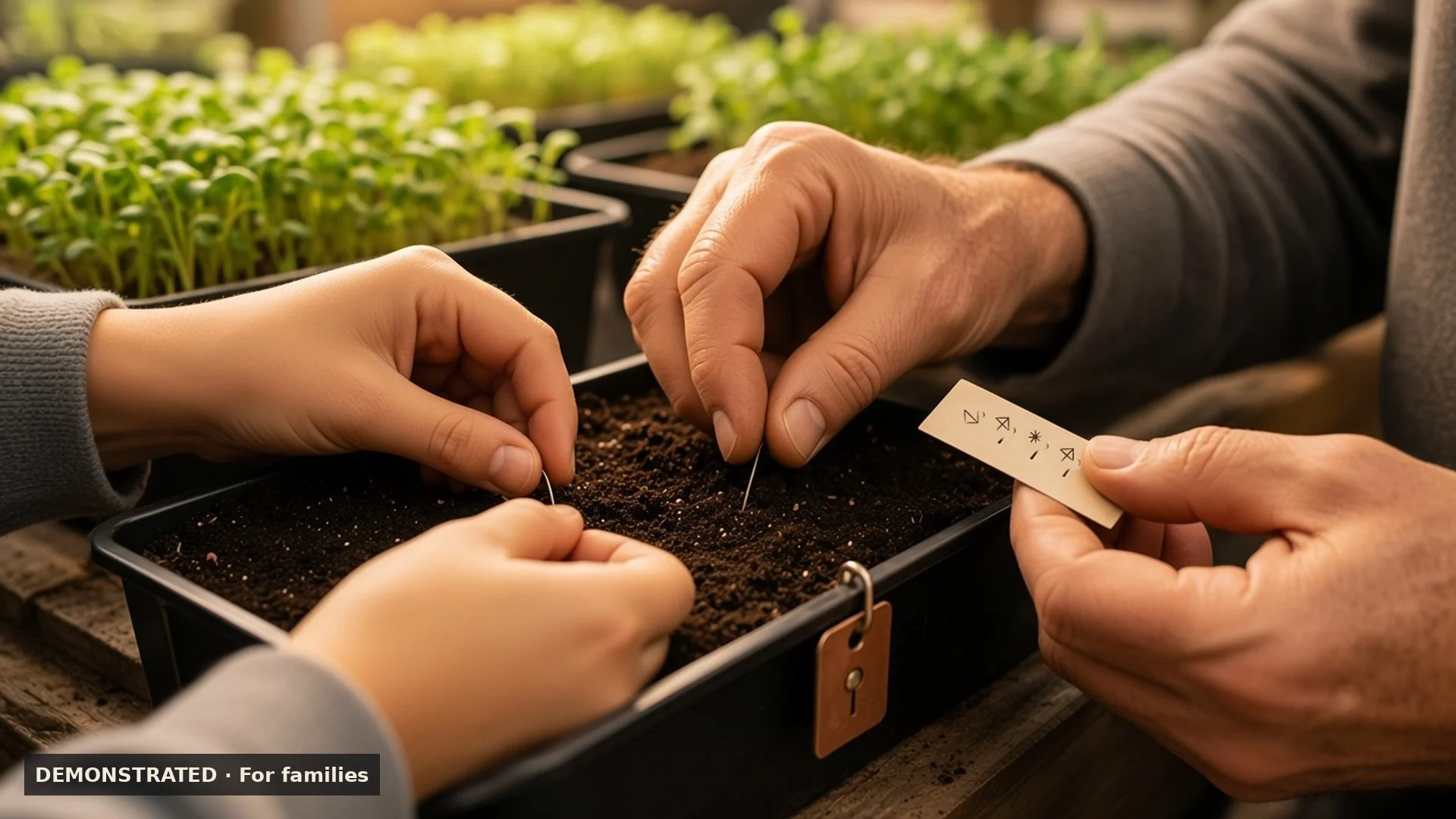
The Gate is built for a family to do together. Children under five are free with an adult and watch from the bench. From five up, every quest is something a parent and child can do side by side, and the Grow Hall's tray is a ten-day project you share. A family of four can expect to spend about the price of a movie night and leave with two verified first skills, a lamp, a printed object, a tray on its way to being food, and a reason to come back on a specific date. Guides are at every bench. Children are always within reach of an adult.
For schools
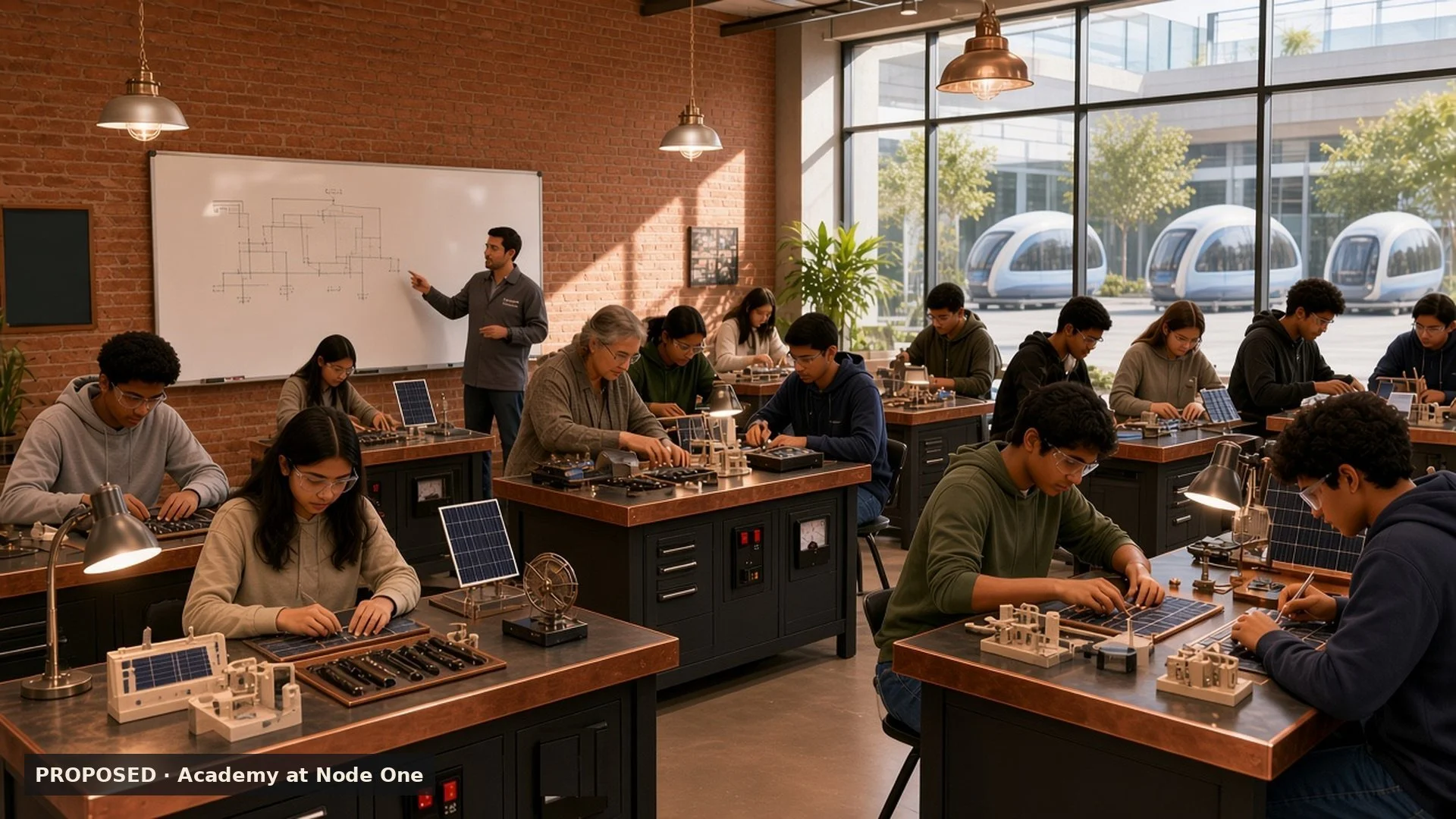
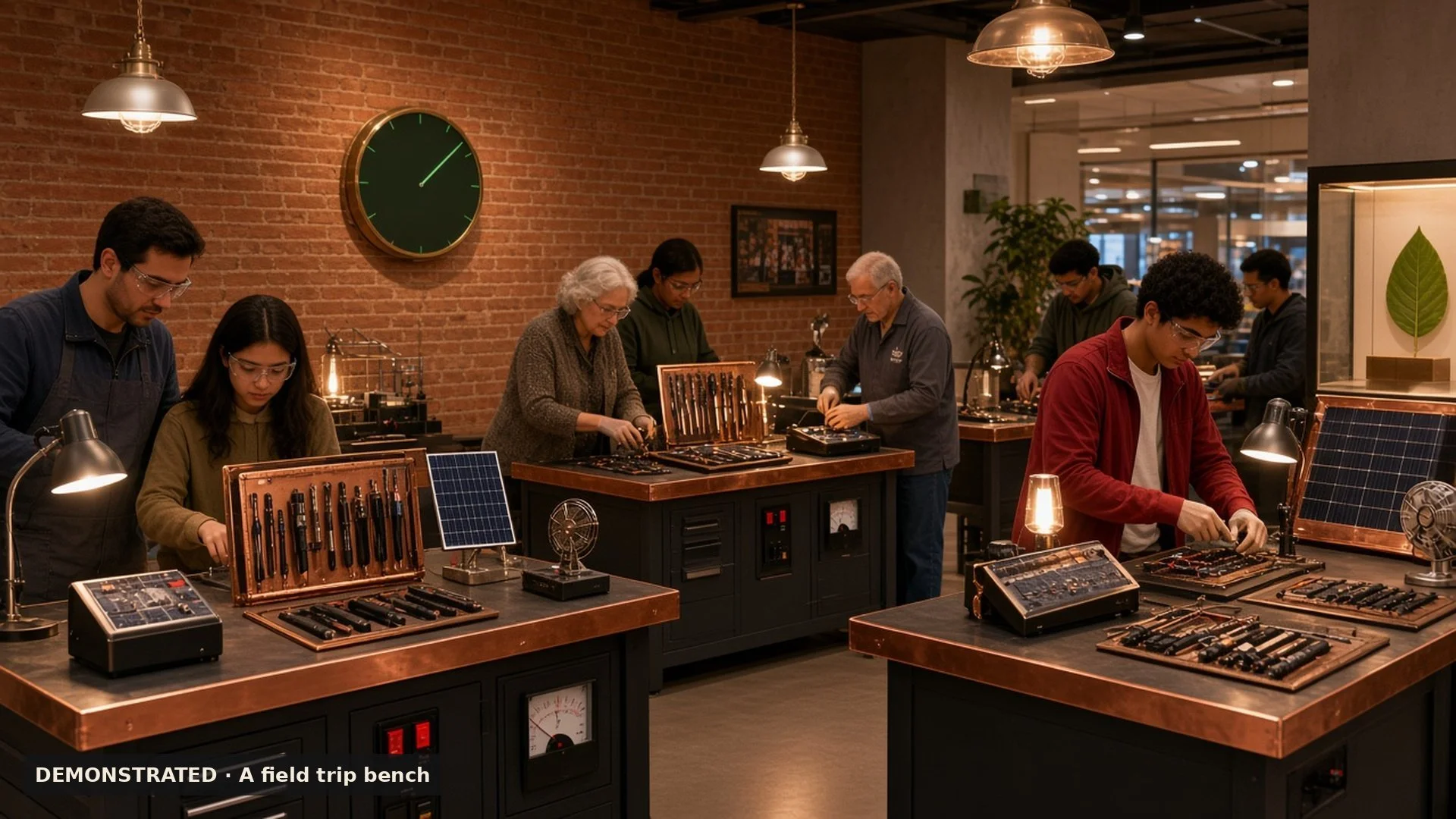
A field trip to the Gate is one ride, one quest and one take-home object per student, with a pre-visit lesson plan mapped to Florida standards and a post-visit code so parents can claim their child's badges. Groups run in a no-account mode: nothing is kept about a student unless a parent later chooses to keep it. One adult is free for every ten students. The Grow quest's harvest is boxed and delivered to the school.
Schools are also how the Gate finds out whether it works. With a district's and parents' consent, school cohorts can join a registered study that compares the Gate's quest format with ordinary good teaching and with a points-and-leaderboards version built only for the study, and measures what students can still do a year later, judged by people who do not work for us. We will publish the result whichever way it falls. At Node One, the Academy will host district-approved instruction and career dual enrollment on site PROPOSED.
For teams
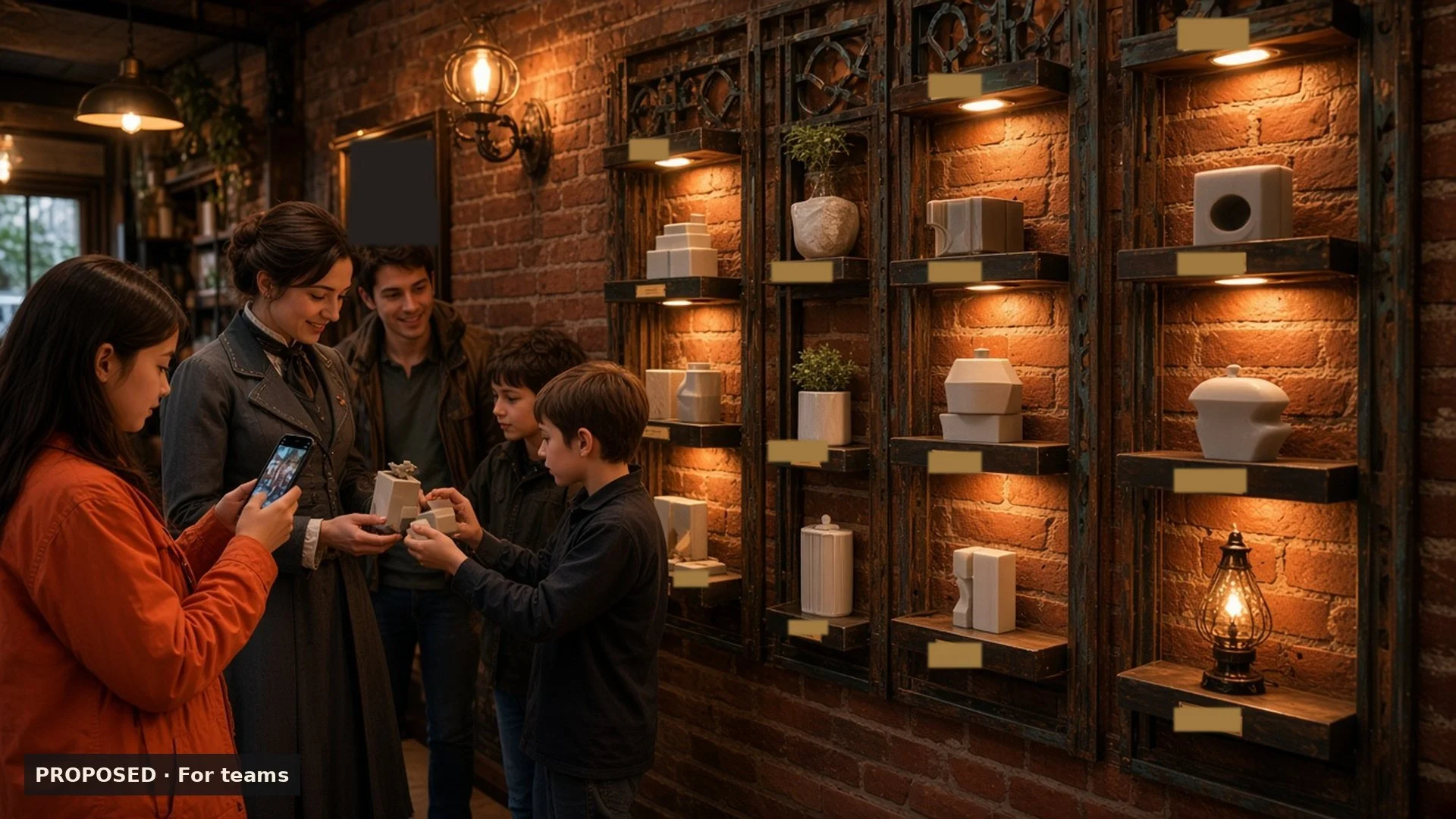
Two-hour sessions for workplaces, scout troops and clubs: a ride, a quest, and a teaching exercise where each person mentors another through a quest with a Guide present. The Gate's version of a team build is a team that made something.
Membership: the Citizen Pass
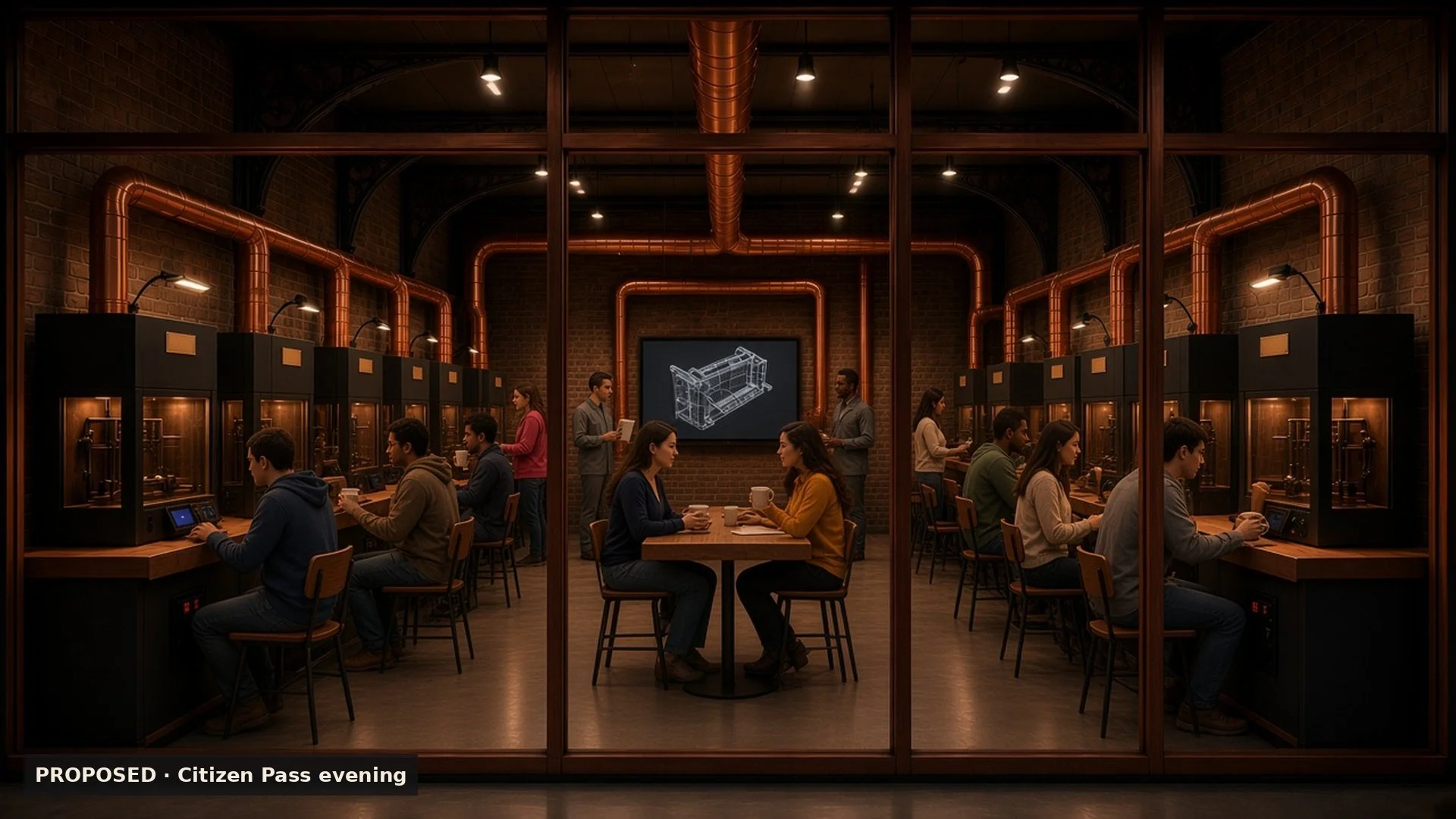
Thirty-nine dollars a month. Unlimited rides. Four bench quests a month. Twenty credits a month. Early booking of session slots. Members' evenings on Tuesdays, where the Design pilot runs: model a part the venue needs and pass a Guide's review. A private crew view for the friends you add in person. And at Level 30, a place on the waitlist for Node One's residency pilot. Twelve-month term, cancel after three. Membership buys time and access; it never buys a level.
The staged path
The papers are blunt about roadmaps: "Calendar roadmaps are how programs like this one lose credibility." So this path has no dates. It has four phases and four gates, and each gate is a published result that someone outside the program confirms. A phase begins when the evidence arrives, not when a quarter ends, and never in a community that would be harmed if it failed.
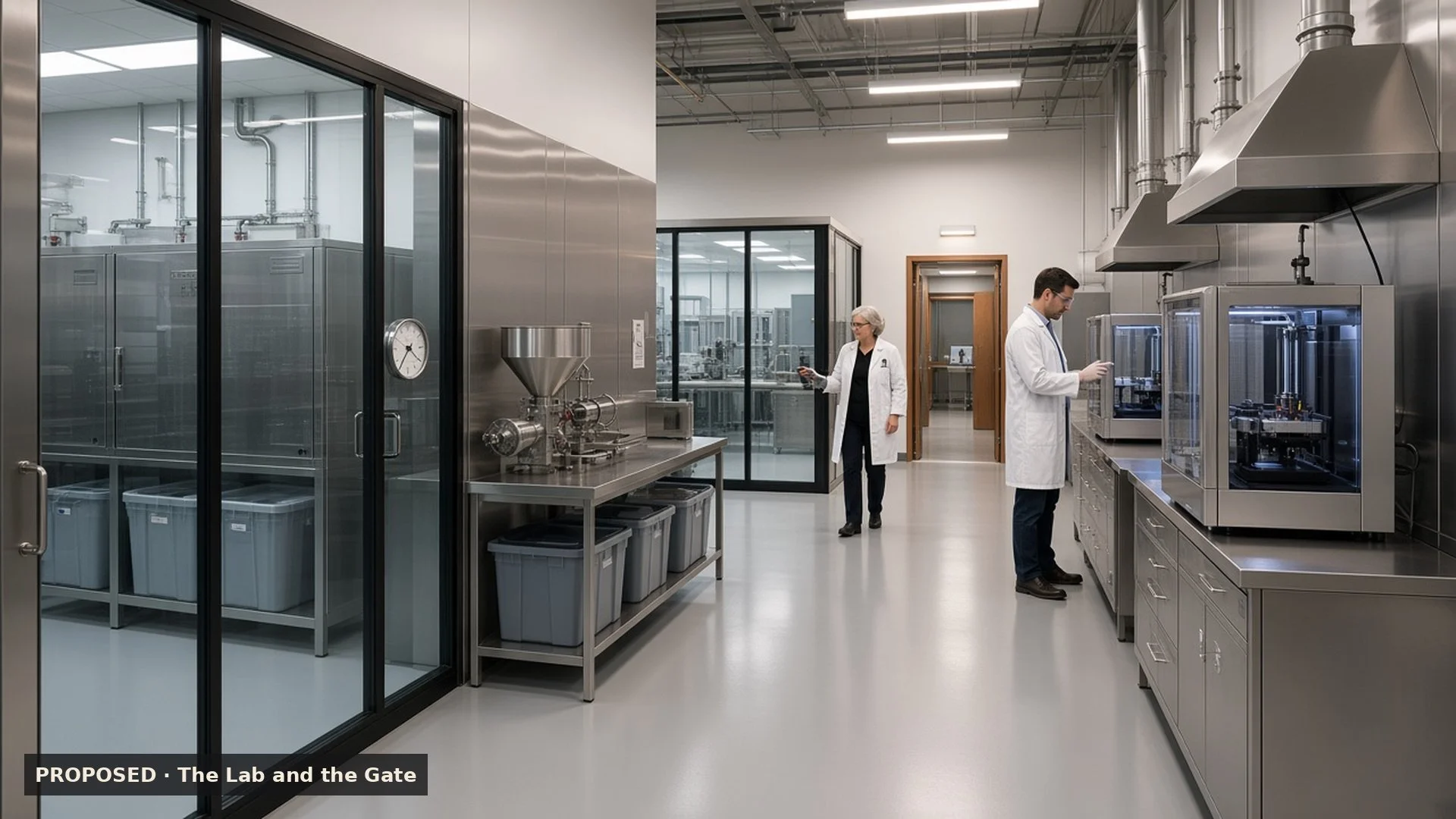
Phase 1: The Lab and the Gate. The first thing built is not a city. It is one laboratory beside a university partner, with a published schedule of what it will prove: a production cell, an analytical bench, a recovery loop, metered energy and water, a process record for every build, and a training bay. The Gate is that lab's training bay and public floor: one mall unit, two pods, four halls, the game at levels 0 to 30, the charter. The gate to Phase 2: two functions verified by an independent laboratory, the cost-per-function method and its first numbers published, the charter and the game's economic rules published for comment, the lab's own machine passing an independence test, and the Gate paying for itself. If the gate fails, no node is built; the lab continues as a materials program, and the Gate continues as a venue if it can.
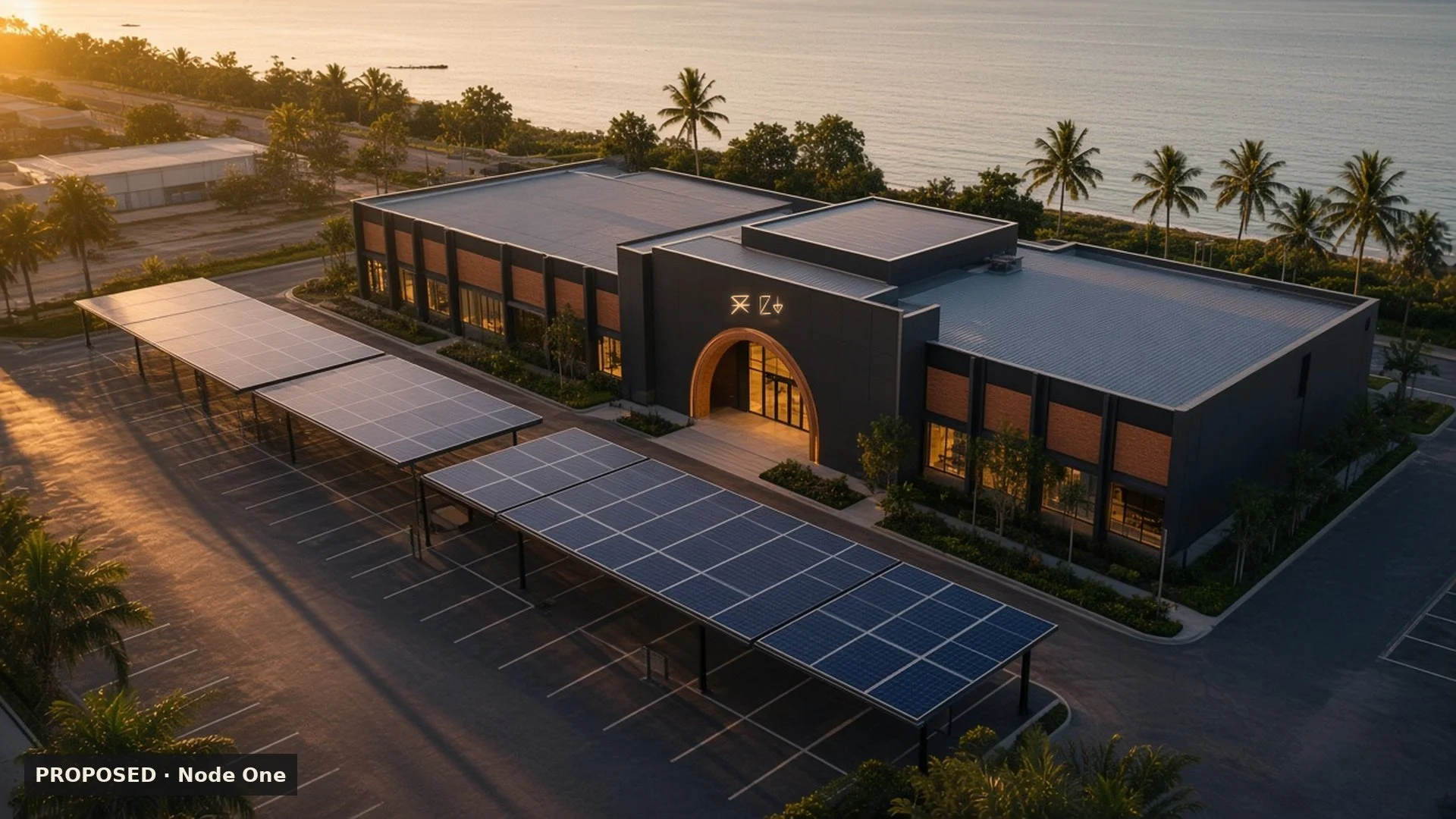
Phase 2: Node One. One hosted pilot, in a building of forty to eighty thousand square feet near the Florida Atlantic coast with its parking lot roofed in solar, six pods, a farm that feeds its own cafe, an Academy, and a small residency pilot where, for the first time, the rule that essentials are unconditional is funded and tested. The host community is in the engineering loop from the first day. The gate: the essentials close to a declared floor in the domains the node declares; a closure drill, watched by an outsider, in which the node holds that floor for a stated number of days without resupply; appeals filed, reported, and some of them won; the school study reporting what students could still do a year on. If the essentials do not close, the program becomes a supplier of specific functions, not a city architecture, and says so.
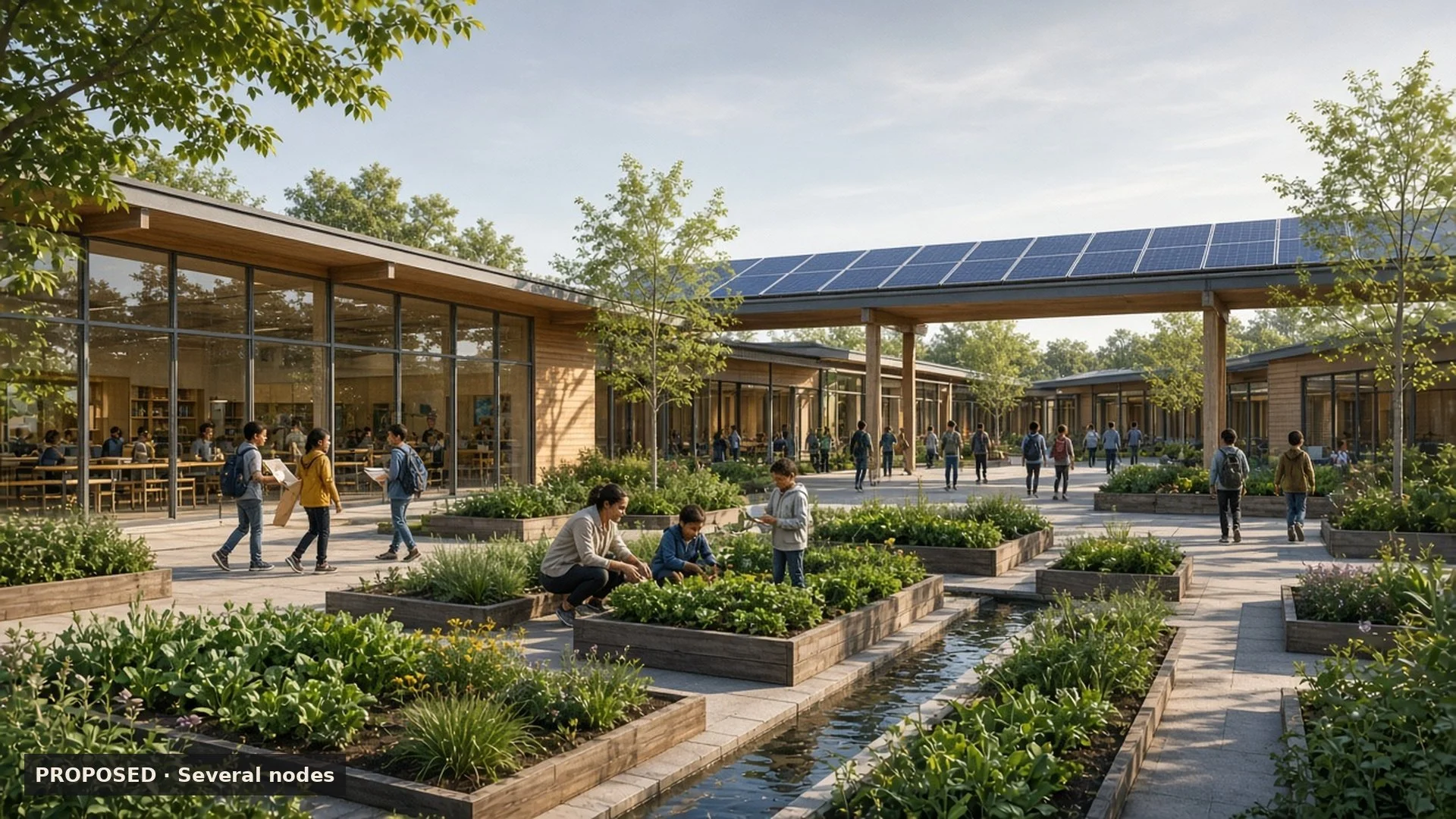
Phase 3: Several nodes. Three to five nodes in different Florida settings, and the hardest test the papers set themselves: a capability package against the same money handed out as cash. If cash wins, the claim narrows to resilience and disruption response, in those words. A second machine, built by people who were not us, must reproduce what the lab qualified.
Phase 4: A network. Nodes supplying each other, recipes moving between them, and the first node this program did not build, reaching its floor with none of our staff on site. Without that, the papers say, this is a product line, and the field should use the smaller word.
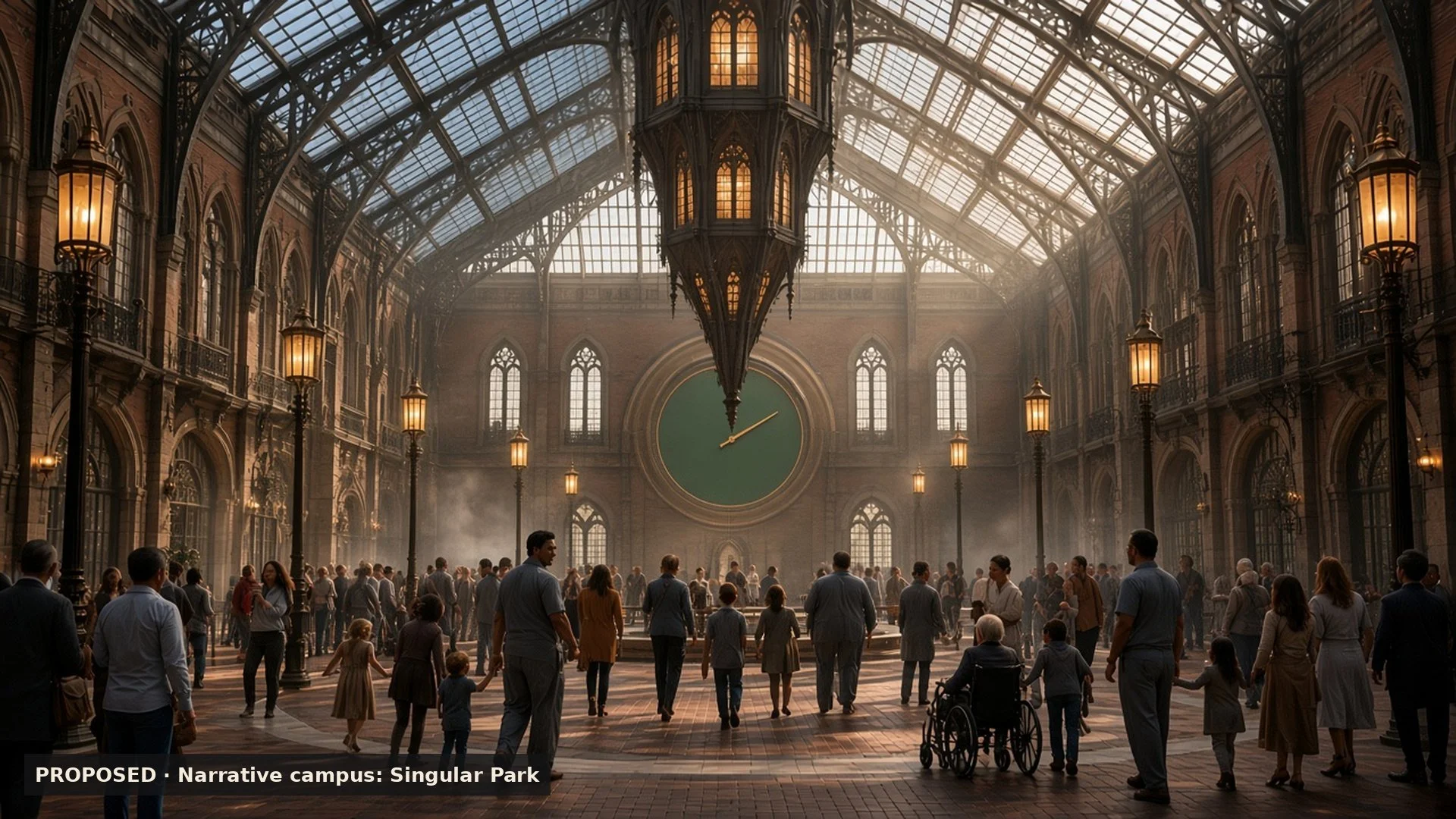
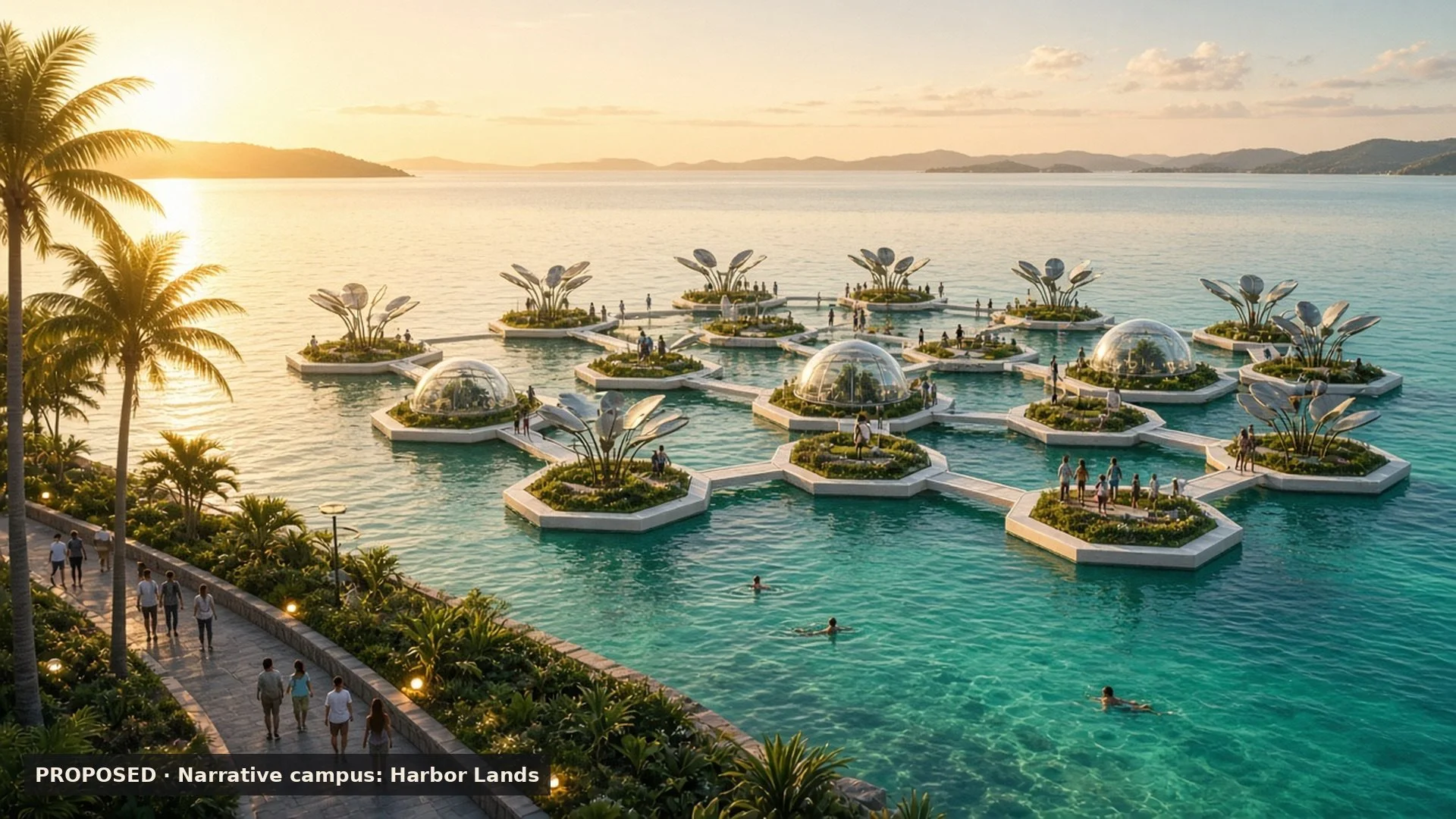
The narrative campus (Singular Park). A park whose rides teach, built from the film's world. It is the story made walkable. It is not a phase and not evidence: every attraction carries its label, its numbers never enter the program's scorecard, and nothing in the phases above depends on it. The Park
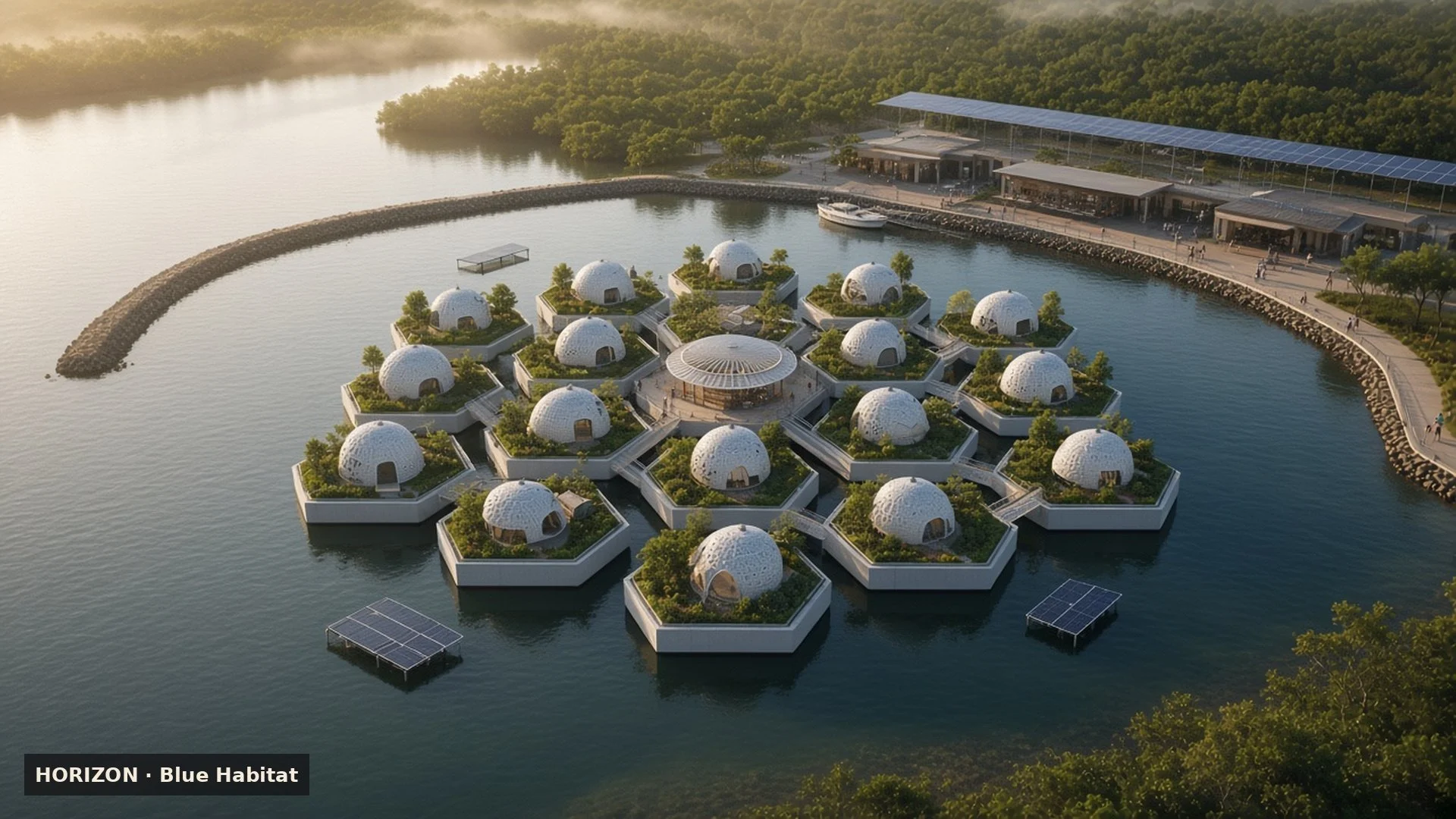
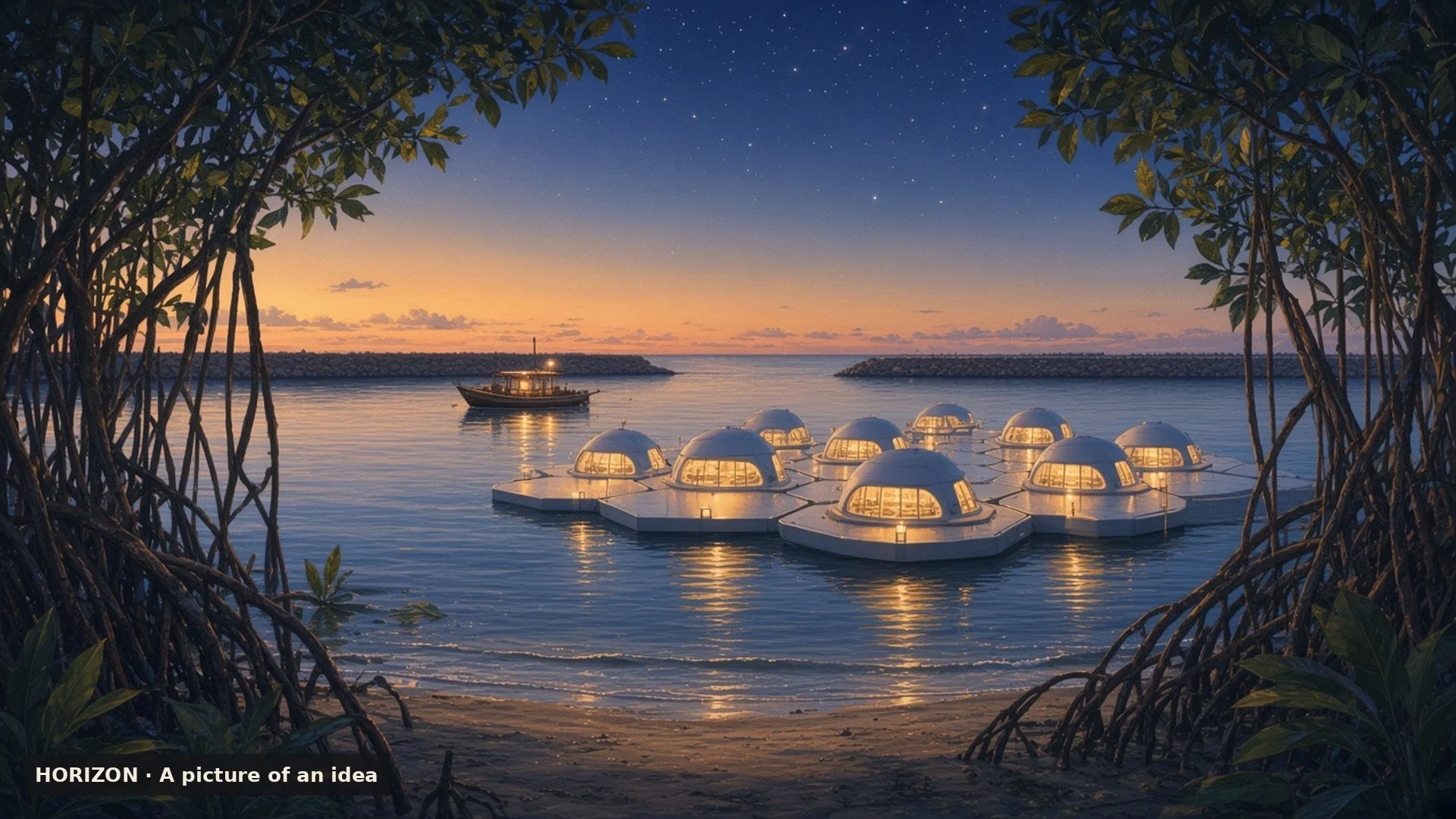
Blue Habitat (HORIZON). Floating neighborhoods of hexagonal platforms in a sheltered lagoon are the picture many people carry of Singular City. The papers keep the picture and put a rule under it: a floating node is built only if it delivers more capability per dollar than the same money on land, and only in three cases. Until the comparison is won, Blue Habitat is a research line, and this picture is a picture of an idea. Node One and beyond
The film
The Gate is built inside the world of Fetus in Fetu, the film trilogy that imagines Singular City from the inside: the two marks over the gate, the quest board hung like a tower, the Loom, the Leaf, the Grow Hall's orchids, the great dial. The halls carry the names of the film's places, the rides tell its lessons, and the shop sells its pins and posters. The venue is where the story becomes a place.
And the story is a story. The papers call it the program's narrative prototype and set the terms: it recruits, it orients, it finds the gaps in our rules before a real person is hurt by them, and it proves nothing. Every technology in the film carries its label. No number, date or outcome from the film appears anywhere in our results, and if you ever see one cited as evidence, that is an error and we want to hear about it.
The science
The Gate is designed from four papers. Here is what each one actually says, one paragraph each, with the claims their earlier drafts withdrew left out, because the papers withdrew them.
Manufacturing Function, Not Only Form (P.02) is not a results paper. It is a pre-registered protocol: eight materials, four ways a payload can fail inside a hot nozzle, an easy panel before a hard one, three independent manufacturing runs, blinded tests, and pass thresholds written down before any data exist, "so that a later report cannot quietly move them." The soap and the leaf on our benches are shipped products that came before that test, and the paper says plainly that none of them was designed as a controlled test. The Ladder on the Discovery wall shows the program and its status, which today is: no data yet.
Programming Matter (P.01) proposes that geometry can encode timing, dissolution can encode state changes, and ambient energy can run a program inside an object, with no battery and no chip. It defines five material instructions (delay, threshold, route, store, release), sets standards of proof for each level of the idea, and specifies five experiments that would make it a field or sink it. It also withdraws several of its own earlier calculations. The Grow Hall teaches the Bloominite seed pod as a program in those five instructions, labeled PROTOTYPE, and measures it the way the companion paper requires: by how many seedlings establish and on how much water, before any larger claim.
Universal Prosperity (P.03) asks a different question from income or services: not whether you can buy what you need or whether society can provide it, but whether you and your community can produce it. It treats the three as complements, not rivals. It supplies the measurements a field needs: a basket of eight essentials, a capability score for each that collapses if the thing is unsafe or unreliable or inaccessible, an index that is never published without its lowest domain beside it, and measures of dependency, resilience and self-replication. It also defines expertise compression, the testable claim that an AI interface can let an untrained person match an engineer, which the Gate's Matter Lab is the right bench to test. And it says the field must be able to prove its founder's own technologies inadequate.
Singular City (P.04) is the founding document of the program this page describes. It defines a discipline, Civilization Bootstrap Engineering, with four commitments: measure against a comparator, measure capability not activity, publish failures, and design for replication by others. It cuts the dependencies: the program does not depend on the Manifester, and could run today with ordinary printers, purchased solar and trained instructors. It writes the charter you read in section 7, separates rights from skills from work from recognition, stages the program through four gates, specifies three experiments that could embarrass it, and lists ten results that would end it. Its first deliverable is one laboratory, not a city.
Behind them stand the sciences the Singular City guide names: game theory and mechanism design, game and economy design, ludology, learning science, systems science and measurement, materials science, energy and water engineering, urban design, narrative design, and the moral framework.
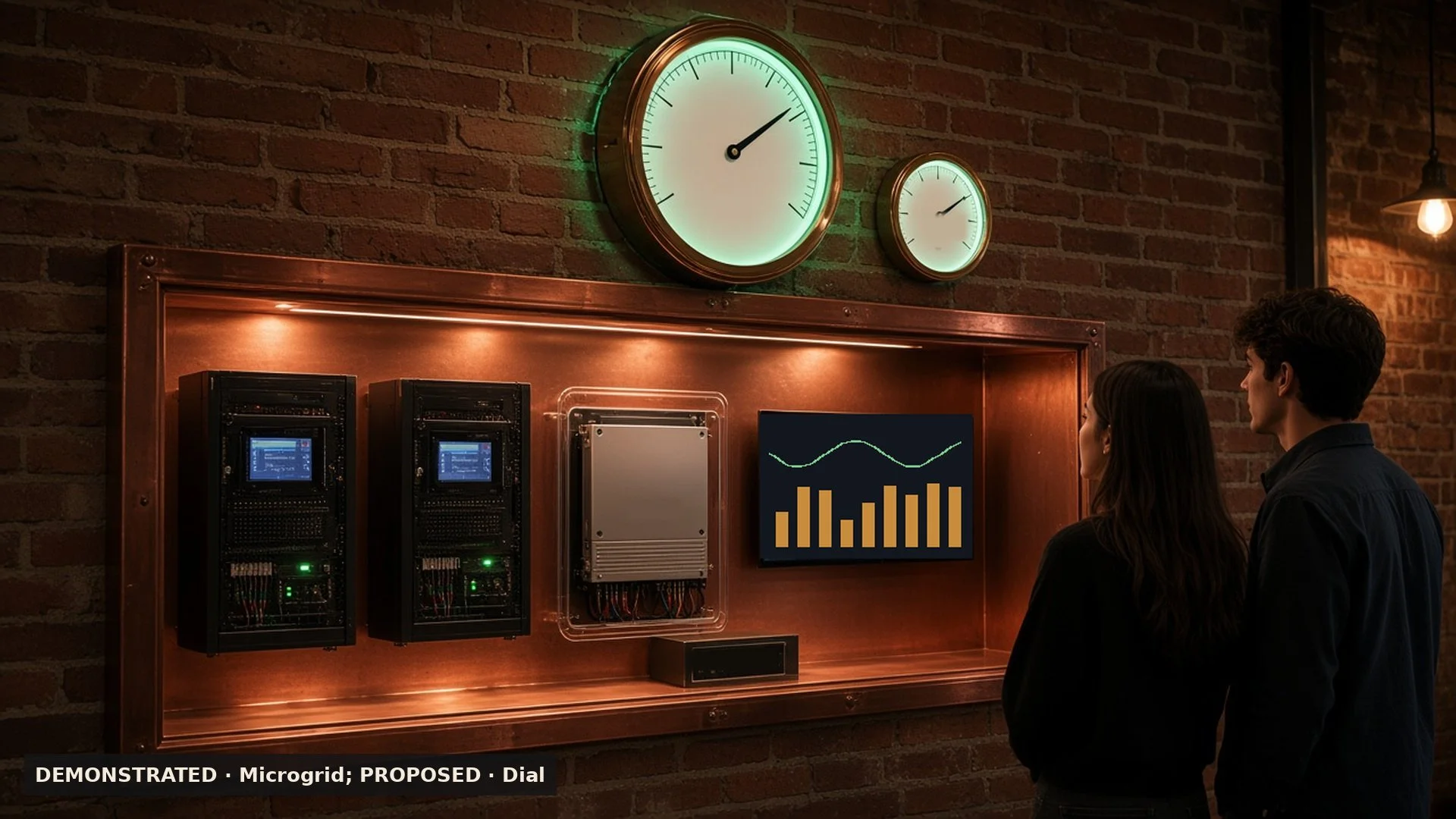
A note on the Dial and the planet. The energy ledger on the Energy Hall's wall shows watts generated and consumed, beside the venue's lowest measure, because the papers say the number that matters is the floor, not the total. When people talk about Singular City as a step toward a "Type I" civilization, we print the papers' own numbers next to the word: the original 1964 definition was about four trillion watts and humanity passed it long ago; the world's energy supply ran near nineteen trillion watts in 2025; later definitions put the threshold far higher. The papers' point is that an energy total "is the wrong instrument," because it measures throughput and says nothing about distribution. That framing is HORIZON, and the film's version of it is fiction.
What would prove us wrong
The papers say a field that cannot say what would refute it is not a field. Here is our list for the Gate, in plain words, written now while it is cheap to write.
If the lab cannot get two functions confirmed by an outside laboratory within twenty-four months, the claim about pace is wrong and we withdraw it. Not delayed. Wrong.
If what the lab makes always costs more than the same thing shipped from a factory, including when shipping is disrupted, then the right architecture is specialized machines and better logistics, and we will say so.
If students in the school study can do no more a year later than students who had ordinary good teaching, then the quest format adds nothing, and the game is dropped rather than defended.
If nobody ever appeals, or appeals and never wins, or if we ever override the independent panel without consequence, the charter has failed no matter how good its text is.
If a second Gate cannot be built from our documentation, or a second machine built by someone else cannot reproduce what the lab qualified, then what we have is a trade secret with a user interface, not knowledge.
If families do not come back, schools decline, and members do not renew at rates that make the venue viable, we have misread what people want. The papers call this the result least often written down and perhaps the most likely.
If anyone is hurt beyond the ordinary rate for a place like this, if the air goes outside the limits we publish, if the audit finds the game favors the already advantaged and we do not change it, the phase stops, and no benefit offsets it.
What would not prove us wrong: a slower timeline than we hoped, a quest that fails, a material that will not qualify, or the floating city staying a picture. Those narrow the program, and the narrowing is written into the gates in advance.
Patch notes
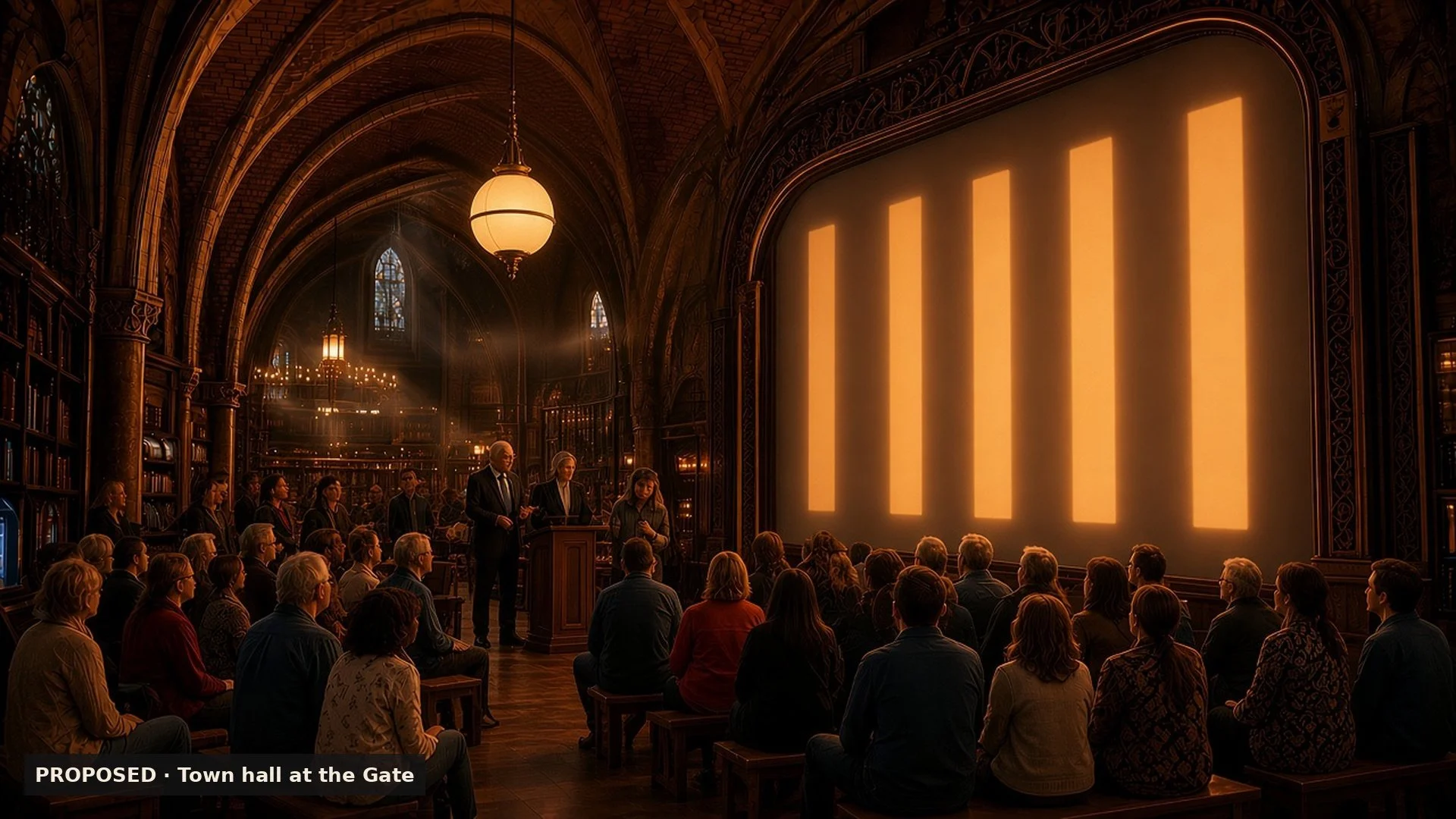
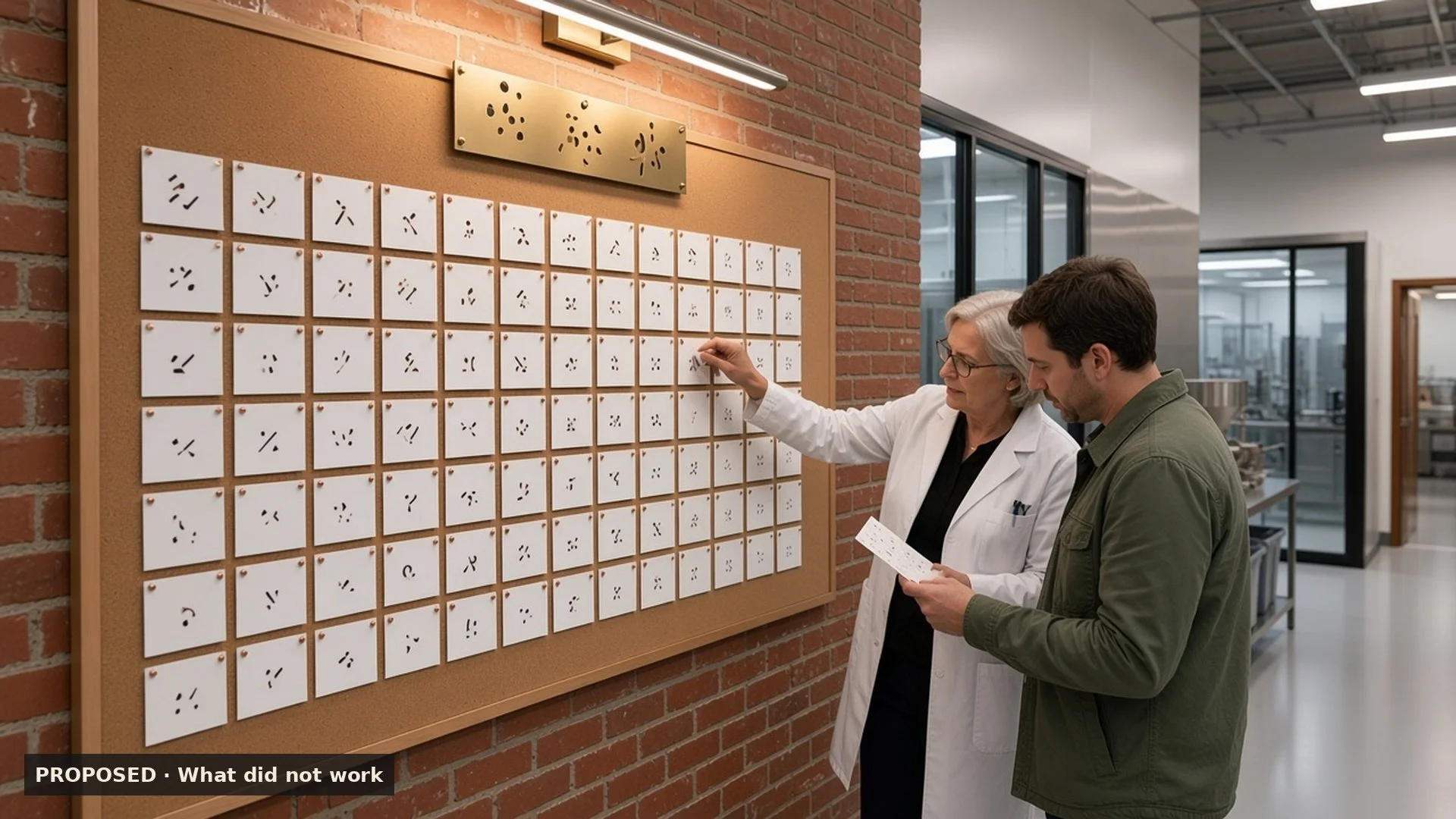
Every month the Gate publishes what broke, what changed, and what gets tested next, along with its numbers: how many first-time visitors left with a skill and an object, how many came back, how many taught someone, how the credit loop balanced, what the board's premium did, how many appeals were filed and how many were won, and a single index that combines the learning numbers so that a strength in one cannot hide a weakness in another, always printed beside its weakest part. The notes also carry a negative-results register: the things we tried that did not work, because a program that reports only successes cannot be told apart from marketing. The notes are read aloud on the first Thursday of the month at LifeQuest HQ, and anyone can come.
Sponsors
A hall sponsorship is a regional company putting its name on the Energy Hall, the Grow Hall or the Matter Lab and funding its equipment and its refresh. Sponsors fund refreshes; they do not write curricula; and the story belongs to the Gate. A sponsorship is not an endorsement of a product by the Gate and does not put a logo inside a ride.
Frequently asked questions
Is this a school? No. The Gate is an attraction where every quest leaves a real skill and a real object behind. It is not accredited and does not issue diplomas. Its badges are its own and are described exactly as what they are: a six-minute lesson and a thirty-minute hands-on quest, verified by a Guide. Where a Gate badge lines up with a real course or certification, we say so and point you to the people who issue it. Whether what you learn here lasts is a question we are testing, not a claim we are making.
Is this a job? Can I earn money here? No. Nobody works at the Gate for credits. Every quest is something you do for your own learning. Everything that keeps the venue running is done by paid staff. Credits are a loyalty reward for finishing a quest, in small fixed amounts, and they only spend at the Gate.
Can I cash out credits, or send them to someone? No. Credits never become cash, never move between people, and never leave the Gate. Purchased credits never expire and carry no fees; earned credits expire after a year.
Does my level give me rights other people do not have? No. Rights do not level up. Your level opens quests and nothing else. Entry, safety, the exit, the appeal and your record are the same for everyone.
What if I disagree with a decision the Gate made about me? Appeal it. Within thirty days, to a human panel, with written reasons and the evidence shown to you. The final stage is two people we do not appoint, from the university partner that hosts our lab and from the school district, and their ruling binds us. We publish how many appeals were filed and how many were won.
What do the labels on everything mean? DEMONSTRATED means measured, with data. PROTOTYPE means built, with early data, not yet checked by anyone outside this company. PROPOSED means a design with a test that could fail. HORIZON means a long-term idea that depends on everything else working. The rides are labeled story, because they are. If something has no label, that is a mistake; tell us.
Is it safe for my child? Guides are at every bench. Anything hot or above 24 volts is behind glass or in a staff-only zone. Children under ten work with an adult at the bench. Every station has an age rule, safety glasses are worn for post-processing, and there are trained first aiders on every shift. School groups keep one adult for every ten students.
What about the air in a room full of 3D printers? Every printer is enclosed with its own particle and carbon filter, the print hall has its own ventilation and exhausts to the outside, and the air is monitored continuously against written limits that we publish. The printers and materials on the public benches are chosen from pairs that have passed the industry's emissions test. There are no resin printers and no laser cutters in the venue.
Are you watching me? Three cameras, at the pods' doors, the print hall's door and the gate, for safety, with a sign at each, thirty days of retention and no analytics. No audio anywhere. No face recognition, no location tracking, no biometrics. The air monitors measure air. That is the whole list, and it is in the charter.
Are the rides amusement rides? The Gate's pods do not move. They are seated lessons with a wraparound screen, sound, wind and warmth. We ask Florida's ride inspectors for a written classification before opening. The first ride that moves, a short train through a tunnel, is planned for Node One and will be permitted and inspected like any amusement ride.
Where will it be? A Central Florida enclosed mall, in a unit of three to six thousand square feet, in the same metro as the university partner that hosts the lab, with a preference for a coastal county so that Node One can be the Gate's own expansion. No site is signed. We will say where when there is a lease. Public listings show the city only.
When? We do not give dates. The lab's gates set the pace, and the Gate opens when it is ready. About twelve months from a signed lease to opening is our planning estimate, and an estimate is all it is.
How much does it cost? The plan is a three-hour session pass in the range of a movie ticket with popcorn, a monthly membership in the range of a streaming bundle, and field trips priced like a science center's. Final prices will be on this page before opening.
Can I bring my own filament or files? Not at the Gate. Every material on the benches is a tested pair with its printer, for air quality and for your print's success. Your own designs are welcome in the Design pilot on members' evenings, through a Guide's review.
Can I take what I make? Yes. Everything you make belongs to you. It is labeled as a learning prototype, which is what it is.
What is the Manifester, and is it at the Gate? PROTOTYPE The Manifester is the printer String Cubed is developing. You speak, and it prints. It works from powder, not filament. One sealed cartridge holds one material. One nozzle opens and closes like a camera diaphragm. It listens, offers materials and levels of detail, then prints from your voice, with no slicer and no files. It is being built to print most of the TimeMass lineup with function preserved, at the level of our published patent application (US 2026/0061664 A1). That is the public description. The Manifester is in development, is not yet available, and no date or price is promised. Details may change. The papers are explicit that Singular City does not depend on it. The Gate opens on proven printers running Timeplast's functional materials, with four bays wired, ducted and reserved for the Manifester when it ships. The ancestor bench next door shows how flakes become pellets and pellets become an object. The Manifester
What can I actually make? A printed block and a printed badge; a soap object; a filter housing and a working gravity filter; a planter from pellets; a jar of recovered flake with its recycle-generation card; a solar lamp, a second lamp to give away, a wired 12 volt circuit; a tray of microgreens; a planted seed pod; a tower of greens. More as the catalog grows, and the patch notes will tell you. Each one carries its label.
What happens to my data? Your record is a nickname, a level, your quests, your credits and your wristband number. For children, a parent signs, and can review or delete the record. No photos, voice or location are collected from children. There is no feed and nothing is shared with third parties without separate consent. You can export your record to any badge wallet, and it stays valid after you leave.
What is the quest board's premium? When a bench is underused, the board raises the experience you earn there, by up to half, and shows the formula. It never lowers anyone's base reward and never ranks anyone.
What is a Lift? Teaching. Once you have done a quest and taken the Lift ride, you can mentor a newcomer through that quest with a Guide present, and both of you earn experience. Teaching is the last step on every path.
What is the yearly audit? A panel of visitors and invited experts, chaired by someone who does not work for us, walks every quest and reads the year's aggregate numbers to see whether the game favors people who are outgoing, able-bodied, wealthy, of one gender, formally educated, or at ease with technology. The findings are published in full, and where it finds a bias, the game changes. You can volunteer for the panel; it is a quest.
Will there be a Gate near me? The first Gate is one venue. If it meets its gates, more may follow. Our benches, kits and recipes are documented so a second Gate could also be built by people who are not us, which is the papers' definition of success. Join the waitlist and tell us where you are.
Join the waitlist
Tell us where you are and who you would bring. We will write when there is a lease, a date, and a price.
This page describes a venue and makes no offer of securities. Offerings by String Cubed, Inc., when any exist, are made only through the compliant materials reached from the offering button on this page.
Disclaimers
Singular City and the Gate are a proposed concept. Plans, not commitments. Nothing on this page has been built, leased, permitted or scheduled. Forward-looking statements on this page are not guarantees of future performance; dates, prices, features and outcomes may change or may not occur as described. Every claim on this page carries one of four labels (DEMONSTRATED, PROTOTYPE, PROPOSED, HORIZON); the label is part of the claim.
The Gate is not a school and does not issue accredited credentials. Its badges describe completed in-venue activities. Any mapping to third-party courses or certifications is informational; those credentials are issued only by their own bodies under their own rules.
Credits are redeemable only for goods and services at the venue, are not redeemable for cash, are not transferable, and are not a security. Purchased credits do not expire and carry no fees. Earned credits are part of a loyalty program and expire as stated at purchase.
The film Fetus in Fetu is a work of fiction. Technologies depicted in it carry their labels where they appear on this site, and nothing in the film is evidence for any claim made here.
STRING CUBED and BLOOMINITE are trademarks of String Cubed, Inc. MANIFESTER is a trademark of Timeplast, Inc., used with permission. The Manifester is in development, is a prototype, is not for sale, and no date or price is promised.
This page makes no offer to sell or solicitation to buy any security. Any offering by String Cubed, Inc. is made only through the compliant materials reached from the offering button on this page.
Questions: info@stringcubed.com
How to read this page
Everything on this page carries one of four labels, the same four the Singular City papers use:
DEMONSTRATED: measured, with data that will be released.
PROTOTYPE: built, with early data; independent checking still to come.
PROPOSED: a design with a test that could fail.
HORIZON: a long-term extrapolation that depends on everything above it working.
The label is part of the claim. A bench that says DEMONSTRATED is a bench we can show you the data for. A card that says PROTOTYPE is telling you that someone outside this company has not checked it yet. A picture labeled HORIZON is a picture of an idea.
And one more rule, printed here because we mean it: the story is a story. The film Fetus in Fetu is the narrative that recruits and orients; nothing in it is evidence. The rides at the Gate are built from the film and are labeled as story. The benches are real and carry their labels. Nothing from the film ever appears in our numbers.
Notice. This narrative proves nothing. Fetus in Fetu is a diegetic prototype of Singular City, published separately from Manuel Rendon's papers and from any result of the program they describe. Every technology it depicts carries a certainty label (DEMONSTRATED, PROTOTYPE, PROPOSED, HORIZON, or narrative only). No number, figure, outcome or date in it may be cited as evidence. It contains failure on purpose.